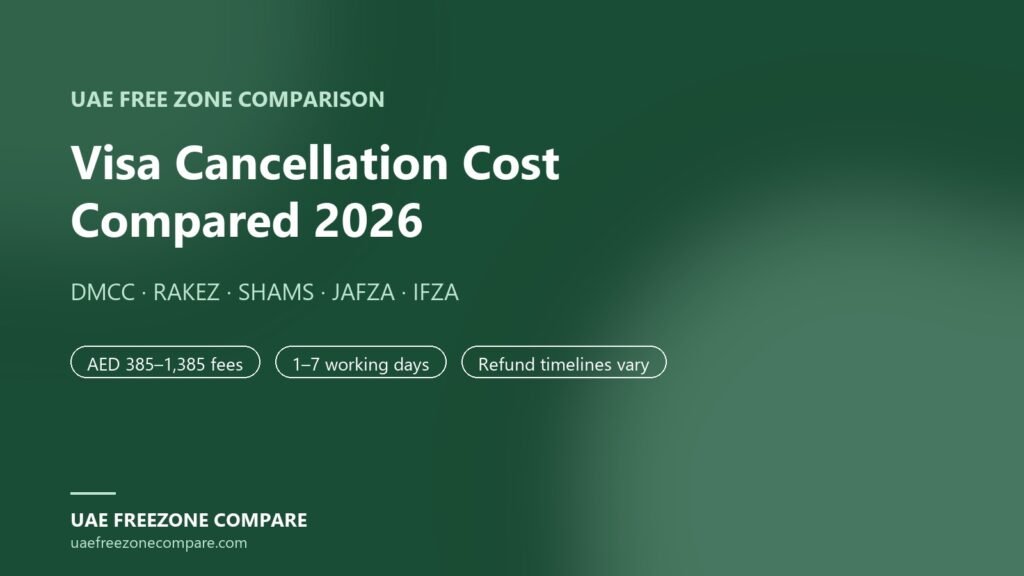
When managing the offboarding of personnel in the UAE, corporate administrators face a highly fragmented cost landscape where a free zone company visa cancellation cost compared 2026 reveals significant divergence between jurisdictions. While Sharjah Media City (SHAMS) charges a flat AED 500 with a 7-day turnaround, Dubai Multi Commodities Centre (DMCC) scales its fees from AED 438 to AED 580 depending on the employee physical location, and Ras Al Khaimah Economic Zone (RAKEZ) spans a wide range from AED 385 for standard processing up to AED 1,385 for express services. Understanding these exact fee structures, processing timelines, and refund mechanics is critical for free zone enterprises seeking to optimize their operational exit costs and maintain regulatory compliance.
What does it actually cost to cancel a free zone employee visa in 2026?
To understand the true cost of terminating a residency visa within a UAE free zone, one must first analyze the multi-tiered administrative structure governing the process. Every visa cancellation initiated by a free zone company must ultimately route through the federal immigration portal managed by the Federal Authority for Identity, Citizenship, Customs & Port Security (ICP). This federal layer introduces a baseline cost that applies universally, regardless of which specific free zone issued the initial sponsorship. This dual-layered system means that companies do not merely pay a single fee; they navigate a combined structure of federal charges and localized free zone administrative markups.
The ICP baseline fees are structured around two primary components. First, the Cancel Entry Permit service fee is set at a flat rate of AED 50. Second, the Smart Application fee adds an additional AED 100 to the transaction. Together, these federal charges establish a mandatory baseline of AED 150 for processing the cancellation request. Under standard operating procedures, the ICP completes this service within a duration of 2 working days. This timeline represents the absolute minimum processing window required for the federal database to update and reflect the cancellation of the entry permit or residency file.
However, free zone companies do not interface directly with the ICP at this baseline rate. Instead, each free zone authority acts as an intermediary sponsor, layering its own administrative, typing, and processing fees on top of the federal baseline. This intermediary layer is where the primary cost divergence occurs. Free zone authorities design their own fee schedules to cover the overhead of managing their respective portals, verifying employment termination documents, and coordinating with federal immigration databases. Consequently, the total amount a company pays to cancel an employee visa is a combination of the federal ICP baseline and the specific free zone administrative markup, which can vary by hundreds of dirhams depending on the jurisdiction, the urgency of the request, and the physical location of the individual.
Free zone visa cancellation fees compared by zone
To assist corporate decision-makers in evaluating these administrative markups, the table below outlines the official visa cancellation fees, processing timelines, and key operational notes for five prominent UAE free zones in 2026. The data is drawn strictly from the official schedules of charges and resource guides published by each respective free zone authority.
| Free Zone | Cancellation Fee | Processing Time | Notes |
|---|---|---|---|
| Dubai Multi Commodities Centre (DMCC) | AED 438 (In-Country) / AED 580 (Out-of-Country) | Not published on official schedule of charges | Charges are non-refundable once the request is typed and submitted to Immigration. |
| Ras Al Khaimah Economic Zone (RAKEZ) | AED 385 (Normal, In-Country) / AED 770 (Normal, Out-of-Country) / AED 885 (Urgent) / AED 1,385 (Royal) | 4 working days (Normal) / 2 working days (Urgent) / 1 working day (Royal) | Surcharges apply for out-of-country processing and expedited timelines. |
| Sharjah Media City (SHAMS) | AED 500 | Approximately 7 working days | Flat fee structure. Security deposit refund is processed only after confirmed exit. |
| Jebel Ali Free Zone (JAFZA) | No flat fee published on public resource guide | 30-day obligation window for completion | Sponsoring company must cancel residence permit, access pass, and Company Employment Card within 30 days of the final working day. |
| International Free Zone Authority (IFZA) | No flat fee published on public resource guide | Not published on official guides | Visa cancellation is bundled procedurally into the broader licence cancellation process. |
The data presented in the table highlights several distinct strategies employed by free zone authorities. The first major point of divergence is the physical location of the employee at the time of cancellation. Both DMCC and RAKEZ impose a substantial surcharge if the employee is outside the UAE when the cancellation is initiated. For instance, DMCC increases its fee from AED 438 for in-country processing to AED 580 for out-of-country processing. RAKEZ exhibits an even steeper escalation, doubling its standard fee from AED 385 (inside the UAE) to AED 770 (outside the UAE). This surcharge reflects the additional administrative complexity of cancelling a visa for an individual who cannot physically sign the cancellation documents within the country or whose entry permit must be invalidated remotely.
The second point of divergence is the availability of expedited processing tiers. RAKEZ is unique in offering a highly structured, multi-tiered speed model. While its standard 4-day service is the most economical option among the compared zones at AED 385, companies facing tight deadlines can opt for the Urgent service (2 working days) at AED 885, or the Royal/express service (1 working day) at AED 1,385. This tiered pricing allows businesses to balance cost against urgency. In contrast, SHAMS maintains a flat-rate model of AED 500 with a fixed, longer timeline of approximately 7 working days, offering no official express path. This flat-rate approach simplifies budgeting but limits flexibility for companies requiring rapid turnaround times.
Finally, JAFZA and IFZA represent a procedural category where flat, standalone visa cancellation fees are not publicly itemized in standard guides. JAFZA focuses on strict timeline compliance, imposing a 30-day obligation window from the employee’s final working day to complete the cancellation of the residence permit, access pass, and Company Employment Card. If the employee has already been outside the UAE for more than 6 months, JAFZA permits the company to apply for cancellation immediately, bypassing certain standard in-country documentation requirements. IFZA, on the other hand, tightly integrates the visa cancellation process with its broader corporate licensing lifecycle. Within IFZA, investor and employee visas must be fully cancelled as a prerequisite before a company can proceed with the complete cancellation of its business licence, reflecting a highly structured corporate wind-down protocol.
How do refund policies differ across free zones?
Beyond the initial administrative fees, corporate cash flow is heavily influenced by how each free zone manages security deposits and refund requests during the visa cancellation process. When a company sponsors an employee, it typically places a security deposit with the free zone authority. Retrieving these funds requires navigating distinct, zone-specific policies that vary widely in terms of timelines and documentation — see our full breakdown of free zone security deposit refunds and deductions for the mechanics that apply beyond visa deposits. Understanding these policies is essential for finance departments to accurately forecast cash recovery timelines during staff transitions.
| Free Zone | Refund Type | Refund Timeline |
|---|---|---|
| Sharjah Media City (SHAMS) | Security deposit refund | 20 to 30 working days from confirmed exit |
| Dubai Multi Commodities Centre (DMCC) | Non-refundable cancellation charges | No refund once typed and submitted |
| Ras Al Khaimah Economic Zone (RAKEZ) | Unprocessed visa deposit refund | No fixed refund timeline published |
| International Free Zone Authority (IFZA) | General refund request | No fixed refund timeline published |
The refund mechanisms of these free zones reveal contrasting administrative philosophies. Sharjah Media City (SHAMS) ties its refund process directly to the physical departure of the individual from the country. The security deposit refund is only initiated after the applicant’s confirmed exit from the UAE has been verified. Once this exit is confirmed, the administrative processing of the refund takes an additional 20 to 30 working days. This policy ensures that the free zone faces no residual liability for an overstaying individual, but it requires the sponsoring company to plan for a prolonged capital lock-up period. For companies managing high turnover, this delay can temporarily tie up significant working capital.
In stark contrast, DMCC enforces a strict non-refundable policy for its operational cancellation charges. Once a cancellation request has been typed and submitted to the Immigration system, the fee of AED 438 (or AED 580) is entirely non-refundable, regardless of whether the cancellation is successfully completed or subsequently aborted by the employer. This places the financial risk of administrative errors or sudden changes in employment status entirely on the sponsoring company, necessitating rigorous internal verification before submitting any portal request.
RAKEZ and IFZA utilize a request-driven refund model. RAKEZ allows companies to reclaim unprocessed visa deposits by submitting a dedicated refund form. However, unlike SHAMS, RAKEZ does not publish a fixed, standardized timeline for completing these visa-cancellation-specific refunds, which can introduce uncertainty into corporate budgeting. Similarly, IFZA requires the submission of a formal refund request form to initiate the return of any eligible balances. Because IFZA bundles visa cancellations into its broader licence cancellation and liquidation framework, the refund process is often tied to the final clearance of the entire corporate entity, making meticulous record-keeping essential for business owners who wish to recover their initial deposits during a company liquidation.
What is the overstay risk if a cancelled visa is not resolved in time?
Once a free zone company successfully processes a visa cancellation, a critical regulatory countdown begins. The cancellation of a residence visa does not immediately render the individual an illegal resident, but it initiates a strict transition window. Under federal ICP regulations, a 30-day grace period is granted immediately following the official cancellation of a residence visa. During this 30-day window, the former visa holder must resolve their legal status within the country. This resolution can take one of three paths: securing new employment under a different sponsor, changing their visa status to a tourist or residency category, or physically exiting the UAE.
Failure to resolve one’s status within this 30-day grace period carries immediate financial penalties. Effective 11 February 2026, the UAE government implemented a major regulatory reform by unifying the visa overstay fine at a flat rate of AED 50 per day. This unified fine applies across all seven emirates and encompasses all visa categories, including tourists, visitors, residents, and individuals holding cancelled residence permits. This means that the moment the 30-day grace period expires, the individual begins accumulating a daily fine of AED 50, with no distinction made based on the emirate of issuance or the original visa type.
This 2026 reform replaced a highly complex and fragmented patchwork of fines that previously varied by emirate and specific visa type. Under the old system, overstaying a cancelled residence visa carried different daily penalties than overstaying a tourist visa, and the rates could escalate over time or differ between Dubai and the Northern Emirates. The unified AED 50 per day fine simplifies the legal landscape but removes any regional leniency or progressive scaling. It establishes a clear, predictable, yet strict penalty structure that demands immediate action from both the individual and the former sponsoring employer.
For free zone companies, this unified fine represents a significant compliance risk. If an employer fails to complete the cancellation process correctly, or if the employee fails to exit or change status within the 30-day grace period, the daily fine of AED 50 begins to accumulate. Because the sponsoring company remains the legal representative of record until the status is fully resolved or the individual exits, unresolved overstay fines can block the company’s portal, preventing them from issuing new visas, renewing licences, or conducting standard business operations. Therefore, tracking the 30-day grace period is as financially vital as managing the upfront cancellation fees.
Which free zone has the cheapest and fastest visa cancellation?
When ranking these free zones to identify the most cost-effective and rapid option for visa cancellation, the choice depends heavily on the company’s specific operational constraints and the physical location of the employee. Because different zones cater to different business models, a single “best” zone does not exist; instead, companies must select a partner based on whether they prioritize upfront savings or rapid processing speeds.
For companies where cost is the primary driver and the employee is physically present inside the UAE, RAKEZ offers the cheapest baseline option. At AED 385 for its normal 4-day service, RAKEZ undercuts DMCC’s in-country fee of AED 438 and SHAMS’s flat fee of AED 500. However, if the employee is outside the country, the financial dynamics shift. In that scenario, DMCC’s out-of-country fee of AED 580 is significantly cheaper than RAKEZ’s out-of-country fee of AED 770. SHAMS remains a stable middle-ground option at a flat AED 500, regardless of the employee’s location, making it highly predictable for remote offboarding.
When prioritizing speed, RAKEZ is the clear leader, provided the company is willing to pay a premium. The RAKEZ Royal/express service guarantees completion in just 1 working day for a fee of AED 1,385. This is faster than the federal ICP baseline of 2 working days and far quicker than the standard SHAMS timeline of 7 working days. For standard, non-expedited processing, DMCC and RAKEZ (normal service at 4 days) represent the most balanced options, aligning closely with standard corporate offboarding workflows.
It is important to note that JAFZA and IFZA cannot be formally ranked on a flat-fee basis. Because neither authority publishes a standardized, standalone visa cancellation fee in their public resource guides, companies operating within these zones must factor in broader operational timelines. JAFZA’s strict 30-day compliance window and IFZA’s requirement to bundle visa cancellations with licence liquidations mean that speed and cost in these zones are dictated by procedural compliance rather than transactional fees. For a company undergoing liquidation, IFZA’s bundled approach is highly efficient, whereas a company seeking to cancel a single employee visa while maintaining active operations will find the clear, itemized fee structures of RAKEZ, DMCC, or SHAMS much easier to manage.
Navigating the complexities of free zone visa cancellations in 2026 requires a detailed understanding of both federal ICP regulations and individual free zone policies. By carefully weighing the upfront fees of DMCC, RAKEZ, and SHAMS against their respective processing speeds and refund timelines, businesses can avoid unexpected operational bottlenecks. Managing these offboarding procedures with precision ensures that companies protect their cash flow, avoid the unified AED 50 daily overstay fines, and maintain a clean regulatory standing within the UAE’s competitive business landscape.
Frequently Asked Questions
What is the unified UAE visa overstay fine in 2026?
Effective 11 February 2026, the UAE unified the visa overstay fine at AED 50 per day across all emirates and all visa categories, including tourist, visit, residence, and cancelled residence permits. This fine applies to anyone who does not exit the country or adjust their legal status within the designated grace period.
Can a company get a refund for a DMCC visa cancellation fee?
No, DMCC visa cancellation charges are explicitly non-refundable. Once a cancellation request has been typed and submitted to the Immigration system, the fee cannot be refunded, regardless of whether the process is completed or cancelled.
How long does the RAKEZ royal visa cancellation service take?
The RAKEZ Royal or express visa cancellation service takes 1 working day to complete and costs AED 1,385. This is the fastest available option among the compared free zones.
What happens if the employee remains outside the UAE for more than six months under JAFZA sponsorship?
If the sponsored employee has already been outside the UAE for more than 6 months, the sponsoring company can apply for immediate visa cancellation through JAFZA, bypassing some of the standard documentation required for in-country cancellations.
When does Sharjah Media City release the security deposit refund?
Sharjah Media City (SHAMS) processes the security deposit refund only after the applicant’s exit from the UAE is officially confirmed. The refund processing takes between 20 and 30 working days from the date of that exit confirmation.
Does the federal ICP fee apply to all free zone visa cancellations?
Yes, all free zone visa cancellations must ultimately route through the federal ICP system. This introduces a baseline cost of AED 150, which includes a Cancel Entry Permit service fee of AED 50 and a Smart Application fee of AED 100, typically completed in 2 working days.