A persistent error runs through the way UAE industrial space is priced online. Business setup aggregators and advisory portals routinely quote the baseline UAE free zone warehouse cost at AED 70 to AED 180 per square metre per year. For 3PL operators, distributors and industrial CFOs modelling a 2026 entry, budgeting on those figures produces a shortfall of several hundred percent.
Verified 2026 research from Knight Frank and CBRE puts real pre-built free zone warehouse rents in prime Dubai and Abu Dhabi corridors between AED 400 and AED 969 per square metre per year — AED 37 to AED 90 per square foot. The cheap numbers in circulation are not warehouse rents at all. They are industrial land lease rates for bare plots, where the tenant funds construction. This report separates the two, benchmarks the 2026 rates that actually apply, and models what a Year 1 commitment costs once the fees behind the rent line are added.
Why do published UAE free zone warehouse costs vary by a factor of five?
The gap comes from conflating two distinct asset classes: pre-built industrial warehouses and industrial ground leases.
When a portal quotes AED 80 per square metre in Jebel Ali or KEZAD, it is describing raw land leased from the free zone authority on a long-term ground lease. Under that structure the occupier carries the full capital burden — civil works, substation, structure, racking and fit-out — and cannot occupy for many months while approvals and construction run.
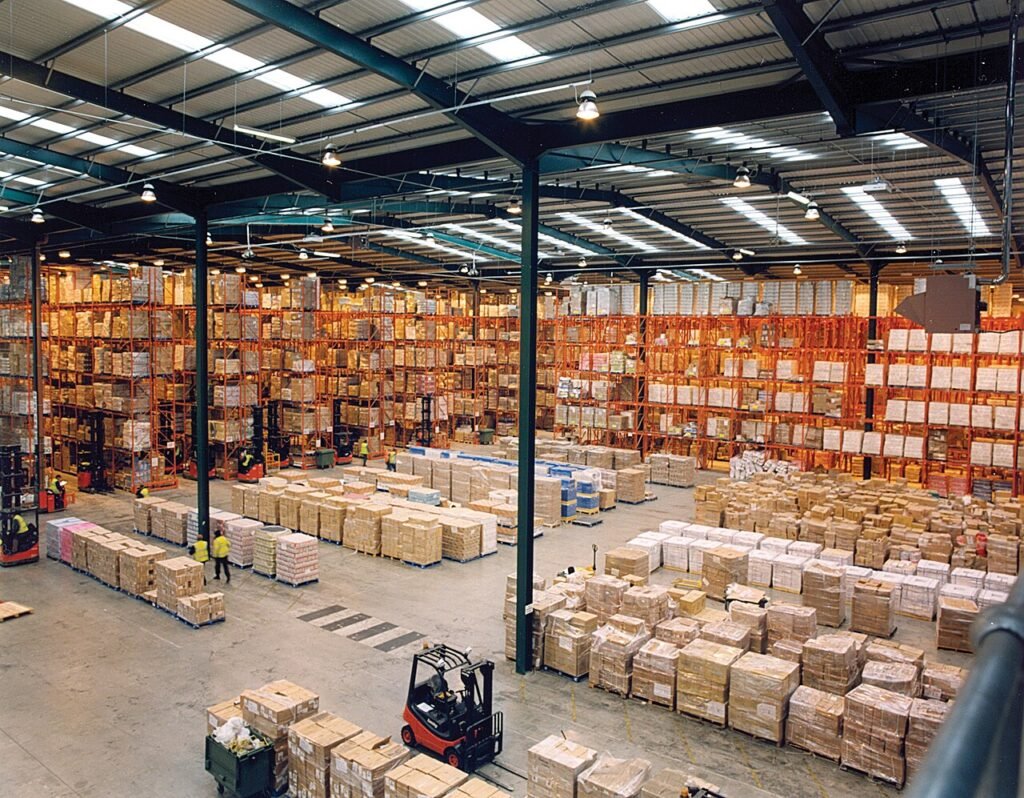
A pre-built warehouse delivers a finished structure: high-load flooring, clear ceiling heights, fire suppression, loading bays, allocated power and attached office space. Authorities price these on structural grade, power availability, location efficiency and immediate readiness. That is why built space sits at three to five times the ground-lease rate — the two numbers are not comparable, and should never appear in the same budget line.
Land lease rates are not warehouse rents
| Property category | Typical rate (AED/sqm/yr) | Typical rate (AED/sqft/yr) | Lease structure | Tenant capital requirement |
|---|---|---|---|---|
| Industrial land lease (bare plot) | AED 70 – AED 180 (figure circulated by setup advisories) | AED 6.50 – AED 16.70 | Long-term ground lease | Extensive — construction, substation, fit-out |
| Pre-built warehouse, prime free zone | AED 431 – AED 969 (Knight Frank, 2026) | AED 40 – AED 90 | Short to medium-term lease | Low to moderate — racking and any chiller upgrade |
Ground leases are not a route to rapid deployment: permitting and construction rule them out for any occupier that needs operating space inside a normal fit-out window. For companies seeking turn-key capacity, the pre-built rate is the only relevant benchmark.
What does a free zone warehouse actually rent for in 2026?
UAE industrial rates repriced sharply between 2024 and 2026. Research from CBRE and Knight Frank shows Dubai industrial lease rates rose around 30% over a two-year period, while Abu Dhabi logged increases of more than 50% over the same window.
Dubai industrial demand reached 12.3 million square feet in H1 2026, up from 11.5 million square feet in H1 2025. Requirements between 10,001 and 50,000 square feet made up 35.5% of demand and the 50,001 to 100,000 square foot band a further 32.2%. Large-format demand above 100,000 square feet expanded to 27% of the total, against 7.8% in H2 2025. By sector, manufacturing and industry drove 35.1% of demand and logistics 15.5%.
On a global basis, prime industrial occupancy costs reached USD 26.43 per square foot per year in Dubai and just under USD 15 in Abu Dhabi, against nearly USD 49 in London and USD 31.60 in Sydney.
| Submarket | Status | Base rate (AED/sqft/yr) | Base rate (AED/sqm/yr) | Year-on-year change | Occupancy and demand profile |
|---|---|---|---|---|---|
| Al Quoz, Dubai | Onshore | AED 90 | ~AED 969 | +6% | Dubai’s most expensive industrial location |
| Dubai South | Free zone | AED 55 | ~AED 592 | +22% | Strongest rental growth in Dubai; prime stock near full occupancy |
| Dubai Investments Park | Onshore, mixed-use | AED 45 – AED 65 | ~AED 484 – AED 700 | Not separately reported | Grade-A logistics and light industrial asking rents |
| JAFZA North and South | Free zone | AED 40 – AED 45 | ~AED 431 – AED 484 | +22% (Grade-A) | Near full occupancy; port-centric logistics demand |
| Dubai Industrial City | Onshore with free zone options | Not disclosed | Not disclosed | +16% | Light and heavy manufacturing demand |
| KEZAD Mussafah (ICAD), Abu Dhabi | Free zone and onshore | ~AED 59 | AED 630 | +15% | Abu Dhabi’s main manufacturing node; tight pre-built supply |
| Al Markaz, Abu Dhabi | Industrial park | ~AED 37 | AED 400 | +7% | Stable expansion area; competitive Grade-A stock |
| Umm Al Thuoob, Umm Al Quwain | Northern Emirates | Not disclosed | Not disclosed | −18.5% | 5.2m sqft available; only submarket where rents fell |
Two findings deserve attention. Dubai South now prices above JAFZA on a per-square-foot basis — AED 55 against AED 40 to AED 45 — having grown 22% in a year, so the assumption that the newer zone is the cheaper one no longer holds. And JAFZA’s own trajectory is steep: prime rents of AED 40 to AED 45 per square foot in H2 2025 compare with AED 33 to AED 37 in H1 2024. Occupiers weighing connectivity against these rates often start by comparing Dubai South, JAFZA and DAFZA for logistics operations, where sea-port and air-side access change the total landed cost more than the rent line does.
How much space do you actually have to take?
Free zones build in standardised modules, so an occupier needing 300 square metres leases a 313 or 500 square metre unit and pays for the surplus. Minimum unit size, not the headline rate, is often what sets the floor on a first-year budget.
JAFZA publishes its unit sizes and specifications
- Light Industrial Units: 313 to 619 square metres.
- Industrial warehouses: from 543 square metres.
- Standard units: 313 to 1,110 square metres, including units with office space of 313 to 670 square metres.
- Jafza Gateway: 187 units totalling 137,279 square metres leasable, individual units 325 to 2,475 square metres.
- Jafza Logistics Park Phase 2: 46,112 square metres across 16 large-format units.
Standard specifications are clear heights of 6 to 12 metres, floor loading of 5 tonnes per square metre, forklift ramps, loading docks, 24/7 CCTV and fire safety systems, with separate entrances for office, showroom and cargo. Power is allocated at 42 to 127 kW on standard units and 10 to 74 kW on Light Industrial Units. Cold storage is available for food, pharmaceutical and healthcare loads. JAFZA does not publish rental pricing — rates are quoted per enquiry.
KEZAD has added capacity where Abu Dhabi supply was tightest
KEZAD Group, part of AD Ports Group, committed AED 621 million to build more than 250,000 square metres of pre-built warehousing: over 97,500 square metres of leasable area at KEZAD Al Mamourah A and B, and over 153,000 square metres at ICAD 3 in KEZAD Musaffah. The mix spans logistics and distribution warehouses, cold stores, light industrial units and showrooms, with pre-built facilities available from around 500 square metres.
Firms whose decision turns on power load or sustainability mandates rather than port access tend to test the Abu Dhabi options against each other, weighing KEZAD against Masdar City, while lighter manufacturers comparing Sharjah’s cost base against Jebel Ali’s connectivity are better served by evaluating HFZA against JAFZA for manufacturing and logistics.
Compare UAE Freezone costs instantly →
What a Year 1 warehouse budget really looks like
Base rent is roughly half of a first-year commitment. The model below takes a 500 square metre Grade-A pre-built unit in a prime Dubai free zone at the Dubai South benchmark of AED 592 per square metre. The rent line is Knight Frank market data; every other line is an indicative planning assumption based on standard regional leasing practice, not a quoted rate, and each should be replaced with the figures on your own term sheet.
| Cost component | Basis | Year 1 budget (AED) | Share of total | Character |
|---|---|---|---|---|
| Base warehouse rent | 500 sqm at AED 592/sqm | 296,000 | 55.6% | Recurring |
| Free zone service charge | Planning assumption: 11% of base rent | 32,560 | 6.1% | Recurring |
| Security deposit | Planning assumption: 10% of base rent | 29,600 | 5.6% | Refundable |
| Utilities and cooling | Planning assumption: AED 45/sqm/yr | 22,500 | 4.2% | Consumption |
| Racking and internal fit-out | Planning assumption: AED 200/sqm | 100,000 | 18.8% | Upfront capital |
| Licence and lease registration | Planning assumption: licence plus registration | 42,000 | 7.9% | Mixed |
| Indicative Year 1 total | Fully landed budget | 532,660 | 100% | Total |
On these assumptions the rent line is 55.6% of the first-year outlay. A budget built on rent alone understates the commitment by roughly 80%. Note also what the rent does not buy: service charges, chiller or district cooling, metered utilities, the deposit, racking and fit-out all sit outside it, and free zone licence and immigration costs are a separate matter from the lease entirely.
Renewal, escalation and the Year 2 problem
UAE free zone leases commonly run on one to three year terms with a contractual escalation applied at renewal. Where escalation is capped in the range of 5% to 10% — an indicative planning band rather than a published figure — expect it to be enforced in full in submarkets sitting at or near full occupancy, which on Knight Frank’s H1 2026 data includes JAFZA, National Industries Park and Dubai South.
The counter-intuitive part is that total Year 2 cash is usually lower than Year 1 even after the increase, because the upfront lines fall away. Applying a 7% escalation to the model above, base rent moves from AED 296,000 to AED 316,720 and the service charge to about AED 34,839. With racking, deposit and registration gone, the Year 2 landed budget lands near AED 404,000 — about 24% below Year 1 despite paying more rent.
Two consequences follow. Cash-flow models that straight-line occupancy costs across a three-year term overstate Year 2 and understate Year 1. And because renewal terms are set against a tightening market, opening the conversation with free zone management well before expiry is worth more than negotiating the headline rate at signing.
Where the market is loosening
Knight Frank expects nearly 2.8 million square feet of new industrial and logistics space to be delivered in Dubai during 2026, the largest annual addition in recent years. CBRE still characterises Dubai as undersupplied in quality warehousing and expects Abu Dhabi rents to keep rising until new inventory arrives, so the relief is real but partial.
The Northern Emirates are the genuine pressure valve: availability there exceeds 10 million square feet, with 5.2 million square feet in Umm Al Thuoob alone, and Umm Al Quwain is the one submarket in the dataset where rents moved down, falling 18.5% year-on-year. For overspill storage, secondary distribution or anything not tied to Jebel Ali Port or Al Maktoum International, that is where the arbitrage sits.
Faisal Durrani, Partner and Head of Research MENA at Knight Frank, has noted that shipping disruption through the Strait of Hormuz has sharpened focus on alternative regional logistics routes — a shift that favours multi-hub warehousing across several emirates rather than concentration in one.
Our verdict
On the evidence for 2026, four conclusions hold:
- Never model a turn-key budget on ground-lease rates. Use AED 400 to AED 969 per square metre for pre-built space. The AED 70 to AED 180 figures apply only if you intend to build on a bare plot under a multi-decade commitment.
- Cheapest depends entirely on what the cargo needs. Sea and air-linked import/export and fast-moving goods justify the premium at JAFZA (AED 431 to AED 484 per sqm) or Dubai South (AED 592). Heavy manufacturing and large footprints price better at Al Markaz (AED 400) or KEZAD Musaffah (AED 630). On rate alone JAFZA is now the cheaper of the two prime Dubai logistics zones — a reversal worth re-testing at every renewal.
- Look north for non-time-critical storage. The Northern Emirates hold over 10 million square feet of availability and are the only part of the market where rents fell.
- Budget the whole Year 1, not the rent. Service charges, deposits, utilities, racking and licensing add roughly 80% on top of base rent in the first year on the assumptions modelled above.
Frequently Asked Questions
What is the average UAE free zone warehouse cost per square metre in 2026?
Annual base rent for pre-built industrial space in prime UAE free zones runs from about AED 400 to AED 969 per square metre, equivalent to AED 37 to AED 90 per square foot. By submarket: JAFZA prime sits at roughly AED 431 to AED 484 per sqm, Dubai South at about AED 592, KEZAD Mussafah at AED 630 and Al Markaz at AED 400.
Why are land lease rates quoted so much lower than warehouse rents?
Land lease rates cover bare, unserviced plots under long-term ground leases where the tenant builds the facility at their own cost. Warehouse rents cover a completed building with power, office space, clear heights, loading docks and fire safety systems already in place. The two are different products, and quoting one as the other is the single most common budgeting error in UAE site selection.
What is the minimum warehouse unit size in JAFZA and KEZAD?
In JAFZA, Light Industrial Units start at 313 square metres and industrial warehouses at 543 square metres. In KEZAD, pre-built units start at approximately 500 square metres across developments including Al Mamourah and ICAD 3. Because stock is modular, an occupier needing less will still pay for the full unit.
What should be budgeted beyond the base warehouse rent?
Service charges, metered electricity and water, district cooling where it applies, a refundable security deposit, lease registration, and capital items such as racking and fit-out. Trade licence and immigration costs sit outside the lease altogether. On the model in this article these lines add roughly 80% to base rent in year one.
How do Abu Dhabi warehouse costs compare with Dubai?
Abu Dhabi is materially cheaper at the prime end. CBRE data puts prime industrial occupancy costs at USD 26.43 per square foot per year in Dubai against just under USD 15 in Abu Dhabi. On headline rents, KEZAD Mussafah at AED 630 per sqm and Al Markaz at AED 400 compare with AED 592 at Dubai South, though Abu Dhabi has been rising faster — more than 50% over two years against around 30% in Dubai.
What rent escalation applies at lease renewal in Year 2?
Free zone leases typically carry a contractual escalation applied at renewal, commonly assumed in the 5% to 10% range, and it is generally enforced in full where occupancy is tight. Total Year 2 cash is still usually lower than Year 1, because racking, deposits and registration do not recur — on the model above, roughly 24% lower despite a 7% rent increase.
Are utilities included in a UAE free zone warehouse rent?
No. Electricity and water are paid on metered consumption to the local utility provider, with connection deposits payable at the start, and district cooling is charged separately where the unit is connected to a network. Confirm which of these the service charge covers before comparing two quotes.
Sources and confidence
- Knight Frank MENA industrial research, H1 2026 and H2 2025: benchmark rents across all submarkets cited, demand volumes and size-band distribution, supply pipeline and the Faisal Durrani comment. Market research estimates and recorded asking rents, not published rate cards.
- CBRE, reported via AGBI: global comparative prime occupancy costs and two-year rental growth for Dubai and Abu Dhabi. Market research estimates.
- JAFZA (jafza.ae): unit sizes, ceiling heights, floor loading, power allocations and facility specifications. Official published specifications. JAFZA does not publish rents.
- KEZAD Group / AD Ports Group: the AED 621 million investment, 250,000 square metres of added capacity, the Al Mamourah and ICAD 3 leasable areas and minimum unit sizing. Official announcements.
Confidence note: unit dimensions, floor loads, power capacities and investment totals are official authority specifications. Rental rates, year-on-year movements and demand metrics are market research from Knight Frank and CBRE. Service charges, deposits, utility allowances, racking costs, licence fees and escalation percentages are indicative planning assumptions, labelled as such throughout, and must be replaced with quoted figures before any commitment.