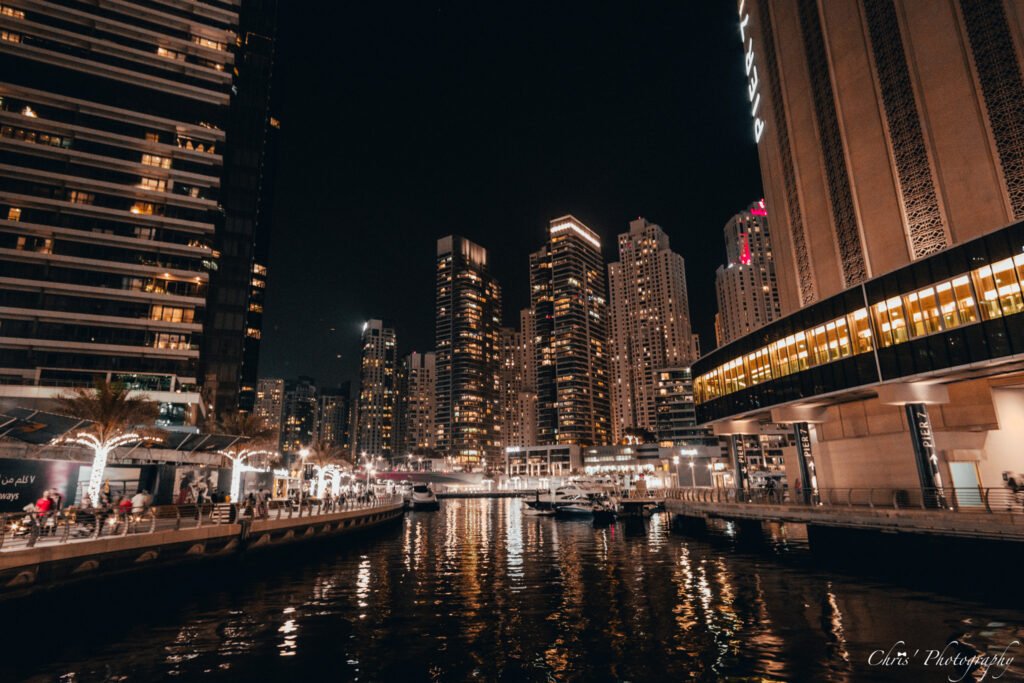
Image: Dubai Marina financial district skyline at night, by Chris Sätian, CC BY 3.0, via Wikimedia Commons.
By UAE Freezone Compare Research Team | September 2026
Ask a founder whether their free zone company needs a registered tenancy contract and the honest answer is: it depends less on the free zone than on the emirate it sits in, and less on the emirate than on whether the company took a dedicated office or a flexi-desk package. The UAE has no single federal tenancy-registration law. Each emirate runs its own system, and a handful of free zones — DIFC, ADGM, KEZAD — opt out of their host emirate’s system entirely and run their own. That patchwork is what this comparison maps, zone by zone, so a founder can tell in advance whether “sign the lease” is the last step or the first of several.
This is not a how-to for completing Ejari itself. For the mechanics of registering a Dubai tenancy contract — documents, portal steps, renewal fees — see Startzone UAE’s Ejari registration guide. What follows is the zone-by-zone question that guide does not answer: which UAE free zones actually route a company’s lease through that system, which run a separate registry, and which skip external registration altogether because the free zone itself is landlord of record.
Why the Registering Authority Follows the Emirate, Not the Free Zone Brand
Free zones are licensing and ownership regimes — 100% foreign ownership, zero personal income tax, a bespoke set of permitted activities. Real estate is a separate layer of regulation that belongs to the emirate the land physically sits in, administered by that emirate’s land department or municipality. Dubai’s Real Estate Regulatory Agency (RERA), part of the Dubai Land Department (DLD), runs Ejari. Abu Dhabi’s Department of Municipalities and Transport runs Tawtheeq. Sharjah Municipality runs its own online tenancy-contract attestation service. Ras Al Khaimah Municipality runs a separate portal. Ajman’s Department of Digital Ajman runs Tasdeeq.
Most free zones sit inside one emirate’s borders and simply inherit that emirate’s tenancy rules for any lease of a dedicated, physical unit. A small number of free zones are carved out as independent common-law jurisdictions with their own courts and their own land registries — DIFC and ADGM are the clearest examples — and for those, the host emirate’s system (Ejari, Tawtheeq) has no jurisdiction at all inside the zone’s boundary.
The second variable, independent of geography, is what kind of workspace the company actually took. A company that leases a standalone office, warehouse or industrial unit is entering a real property transaction that the applicable authority wants on record. A company that buys a flexi-desk or shared-desk package is not leasing identifiable, exclusive space — the free zone authority itself remains the landlord of the building, and it issues its own internal lease document that its own immigration and establishment-card processes accept without a separate external filing.
Zone-by-Zone: Registering Authority and Whether Registration Is Mandatory
| Free Zone | Emirate | Registering Authority | Mandatory for a Dedicated Unit? | Flexi-Desk Exemption? |
|---|---|---|---|---|
| DMCC | Dubai | Ejari (DLD/RERA) | Yes | Yes — DMCC Business Centre and shared units use DMCC’s own lease document instead |
| JAFZA | Dubai | Ejari (DLD/RERA) | Yes | Yes — business-centre and flexi packages use JAFZA’s own agreement |
| DAFZA | Dubai | Ejari (DLD/RERA) | Yes | Yes, for shared-desk packages |
| Dubai South | Dubai | Ejari (DLD/RERA) | Yes | Yes, for shared-desk packages |
| Meydan Free Zone | Dubai | Ejari (DLD/RERA) | Yes | Yes, for shared-desk packages |
| IFZA | Dubai | Ejari (DLD/RERA) | Yes | Yes, for shared-desk packages |
| DIFC | Dubai (independent jurisdiction) | DIFC Registrar of Real Property (own registry, not Ejari) | Yes | No — DIFC leases are registered with the DIFC Registrar regardless of size |
| SHAMS (Sharjah Media City) | Sharjah | Sharjah Municipality tenancy attestation | Yes | Yes — SHAMS flexi-desk packages carry SHAMS’s own lease agreement |
| SAIF Zone | Sharjah | Sharjah Municipality tenancy attestation | Yes | Yes, for shared-desk packages |
| RAKEZ | Ras Al Khaimah | RAK Municipality online tenancy registration | Yes | Yes — RAKEZ’s own flexi-desk office agreement covers shared packages |
| Ajman Free Zone (AFZA) | Ajman | Tasdeeq (Ajman mainland system) | Yes, for a standalone unit | Yes — AFZA flexi-desk packages typically bypass Tasdeeq |
| KEZAD | Abu Dhabi | KEZAD’s own tenancy registration (not Tawtheeq) | Yes | No — KEZAD registers its own leases regardless of size |
| ADGM | Abu Dhabi | ADGM’s own registration (not Tawtheeq) | Yes | No — ADGM registers its own leases regardless of size |
Dubai’s Free Zones Route Through Ejari — With One Consistent Carve-Out
DMCC, JAFZA, DAFZA, Dubai South, Meydan Free Zone and IFZA are all Dubai-based, which means a lease for a dedicated office, warehouse or industrial unit inside any of them is a Dubai property transaction and goes through the same Ejari system RERA runs for the rest of the emirate. DMCC states this explicitly in its own licence-renewal guidance: an Ejari certificate number is mandatory for leased units, with a named exception carved out for the DMCC Business Centre, non-DMCC business centres, common areas, plots, shared units and the DMCC Tea Trading Centre — precisely the flexi-desk and shared-space categories, which use DMCC’s own lease documentation instead.
The practical reason this matters is immigration, not just real estate compliance. Dubai’s General Directorate of Residency and Foreigners Affairs (GDRFA) requires proof of a valid tenancy — an Ejari certificate for a dedicated lease, or the free zone’s own package documentation for a flexi-desk arrangement — before it will process establishment cards and the employment visas linked to a company’s visa quota. A company that quietly lets its dedicated-unit Ejari lapse can find its next visa renewal rejected on a paperwork technicality that has nothing to do with the underlying licence.
None of this changes what a free zone company actually pays for office space, which is a separate question — see our Free Zone Office Lease Charges Compared 2026 breakdown of deposits, attestation and municipality fees by zone, and the cost of downgrading from a dedicated lease to a flexi-desk mid-term.
Compare UAE Freezone costs instantly →
DIFC Runs Its Own Registry, and Ejari Has No Reach Inside It
DIFC sits geographically inside Dubai, which leads some founders to assume Ejari applies. It does not. DIFC is a separate common-law jurisdiction with its own courts, and property inside its boundary is governed by the DIFC Real Property Law and DIFC Leasing Law, administered by the DIFC Registrar of Real Property. Every lease in DIFC — dedicated office or shared workspace — must be in writing and registered with the DIFC Registrar, not with DLD, and a DIFC lease never generates an Ejari certificate. The obligation to register is arguably stricter than Dubai’s mainland system, because DIFC does not carve out a flexi-desk exemption the way DMCC, JAFZA and the other Dubai free zones do — every DIFC tenancy, regardless of size, goes through the Registrar.
Sharjah, Ajman and Ras Al Khaimah Each Run a Separate Emirate-Level System
Outside Dubai and Abu Dhabi, the three northern-emirate free zones covered here each answer to their own municipality rather than to a DLD-style federal-sounding brand name, which is part of why the requirement is easy to miss when a founder’s only reference point is Dubai’s Ejari.
Sharjah (SHAMS, SAIF Zone). Sharjah Municipality runs its own electronic tenancy-contract attestation service, separate from Ejari. Attestation is mandatory for trade licence issuance and renewal, and for family and residency visa applications tied to the lease. A standard SHAMS package pairs the trade licence with a flexi-desk and a lease agreement sized to the company’s visa quota — that package-level agreement is what supports the visa quota directly, without a separate municipality filing. A dedicated office or warehouse unit in SHAMS or SAIF Zone is a different transaction and is expected to go through the same municipal attestation any Sharjah tenancy does.
Ras Al Khaimah (RAKEZ). Registering a commercial tenancy contract is mandatory across RAK Emirate, processed online through RAK Municipality for a flat AED 25 plus 5% of the annual lease value, typically completed within two working hours. That requirement applies to a standalone leased unit. RAKEZ’s own flexi-desk and shared-office packages are covered by RAKEZ’s internal office agreement, which functions the same way DMCC’s or JAFZA’s business-centre exemption does — it is the free zone, not RAK Municipality, that is the counterparty of record.
Ajman (Ajman Free Zone / AFZA). Ajman’s Department of Digital Ajman runs Tasdeeq, which authenticates lease contracts for both residential and commercial units at 2% of the lease value with a minimum of AED 400. Tasdeeq is squarely a mainland-Ajman requirement for a standalone leased property. Ajman Free Zone company formation instead commonly runs on a flexi-desk lease priced independently of Tasdeeq, with the signed agreement simply attached to the licence application rather than authenticated through the municipal system.
Abu Dhabi’s Free Zones Sit Entirely Outside Tawtheeq
Tawtheeq — the tenancy registration system run by Abu Dhabi’s Department of Municipalities and Transport — governs mainland Abu Dhabi tenancies only. Properties inside KEZAD, ADGM, Masdar City and twofour54 are regulated by each free zone’s own tenancy-registration system, and a Tawtheeq certificate carries no weight inside any of them. KEZAD and ADGM both register leases directly with the free zone authority itself rather than delegating to a landlord-facing municipal portal, which means there is effectively no flexi-desk carve-out in the Dubai or Sharjah sense — the free zone is the registry for every tenancy it issues, dedicated or shared, because it is also the one issuing the lease.
For founders comparing DIFC against Abu Dhabi’s financial free zones specifically, the underlying office-space question sits alongside a separate licensing decision — see our Family Office Licence Cost Compared: DIFC vs ADGM vs DWTC comparison, where the same DIFC-runs-its-own-registry point applies.
Bottom Line
“Free zone” is not, by itself, an answer to whether a lease needs external registration. The zones that sit inside a single emirate’s ordinary land-department jurisdiction — DMCC, JAFZA, DAFZA, Dubai South, Meydan, IFZA in Dubai; SHAMS and SAIF Zone in Sharjah; RAKEZ in RAK; Ajman Free Zone in Ajman — all require a dedicated office or warehouse lease to be registered through that emirate’s own system (Ejari, Sharjah’s attestation service, RAK Municipality or Tasdeeq), and every one of them exempts flexi-desk and shared-desk packages because the free zone itself is the landlord of record. DIFC, ADGM and KEZAD are the exception to the exemption: each runs its own independent registry that applies to every tenancy inside its boundary, dedicated or shared, with no flexi-desk carve-out. The practical rule for any founder signing a lease is simple — check whether the space is dedicated or shared before assuming the answer, and check which registry the emirate (or the zone’s own independent jurisdiction) actually uses before assuming it is Ejari by default.
Frequently Asked Questions
Do all UAE free zone companies need Ejari?
No. Ejari is specific to Dubai and is administered by the Dubai Land Department. It applies to dedicated-unit leases inside Dubai-based free zones such as DMCC, JAFZA, DAFZA, Dubai South, Meydan and IFZA. Free zones in other emirates use that emirate’s own system instead — Sharjah Municipality’s attestation service, RAK Municipality’s online registration, or Ajman’s Tasdeeq — and DIFC, ADGM and KEZAD run independent registries that never touch Ejari at all, regardless of which emirate they sit in.
Which free zones are exempt from external tenancy registration?
None are fully exempt, but most exempt flexi-desk and shared-desk packages specifically. DMCC, JAFZA, DAFZA, Dubai South, Meydan, IFZA, SHAMS, SAIF Zone, RAKEZ and Ajman Free Zone all accept the free zone’s own internal lease agreement for a shared-desk package in place of Ejari, Sharjah attestation, RAK Municipality registration or Tasdeeq. DIFC, ADGM and KEZAD do not offer this carve-out — every tenancy in those three, dedicated or shared, is registered with the zone’s own registry.
What happens if a free zone lease is not registered?
The consequences depend on which registry applies, but the pattern is consistent across the UAE: an unregistered or lapsed tenancy contract blocks establishment-card issuance and employment visa processing tied to that address, and it removes the tenant’s standing to use the rental dispute mechanism the relevant authority runs (RERA’s rental committee in Dubai, the equivalent bodies elsewhere). A lease that is signed but never registered functions like a lease that does not exist for both immigration and dispute-resolution purposes.
Does DIFC use Ejari?
No. DIFC is an independent common-law jurisdiction inside Dubai with its own courts and its own property law. Leases in DIFC are registered with the DIFC Registrar of Real Property under the DIFC Leasing Law, not with the Dubai Land Department, and a DIFC tenancy never generates an Ejari certificate — even though DIFC sits geographically within Dubai’s borders.
Is a flexi-desk package enough for a UAE residence visa?
In the Dubai, Sharjah, RAK and Ajman free zones covered here, yes — the free zone’s own flexi-desk lease agreement is sized to the company’s visa quota and is what GDRFA and the equivalent emirate-level immigration authorities accept as proof of address for establishment cards and employment visas. It is only when a company upgrades to a dedicated office or warehouse that a separate external registration (Ejari, Sharjah attestation, RAK Municipality, Tasdeeq) becomes the document immigration expects instead.
How much does RAK tenancy contract registration cost?
RAK Municipality charges a flat AED 25 service fee plus 5% of the total annual lease value for online tenancy contract registration, and processing typically takes about two working hours once the signed contract and title deed reference are submitted. This applies to a standalone leased unit; RAKEZ flexi-desk packages are covered by RAKEZ’s own internal office agreement instead.