
Why are you still paying “consultancy fees” when the cost difference between an entry-level free zone permit at AED 5,750 and a more established license option at AED 12,500 is exactly AED 6,750? You’ve likely spent hours staring at brochures filled with marketing jargon, only to realize the “all-inclusive” price often leaves out your Emirates ID or medical tests. It’s exhausting to plan a budget for your UAE Freelance visa when the regulatory goalposts keep moving.
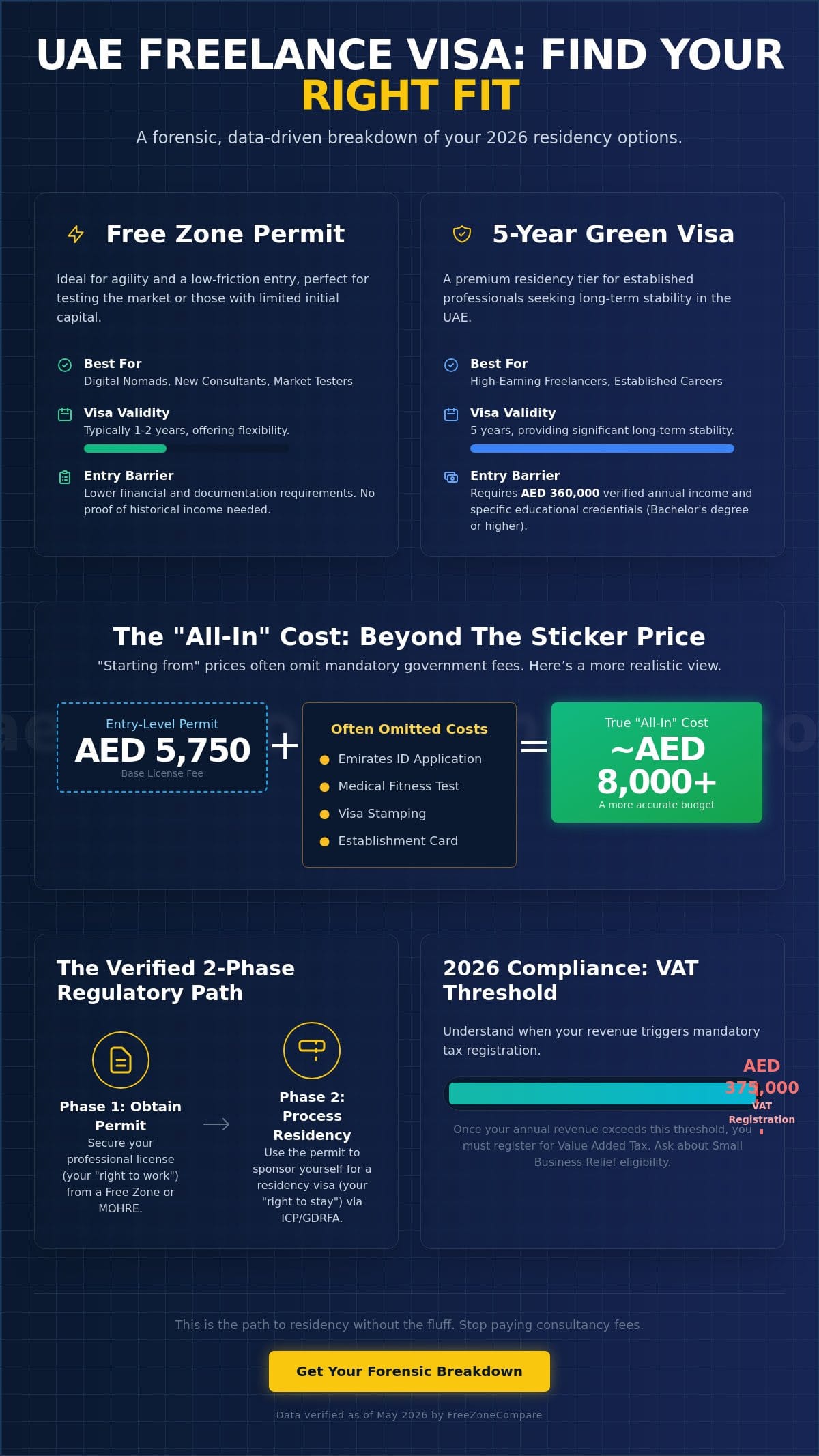
At UAE Freezone Compare, we’re not a consultancy, and we don’t take commissions from free zones. Our team provides a forensic, data-driven breakdown of your residency options using verified figures from May 2026. You’ll get a clear, apples-to-apples comparison of the most cost-effective permits available across different jurisdictions versus options in more established or premium locations. We’ll also explain the 5-year Green Visa income requirements and the exact moment your revenue triggers the AED 375,000 VAT threshold. This is the path to residency without the fluff.
Key Takeaways
- Identify the true “all-in” cost of a UAE Freelance visa. Account for the mandatory fees that “starting from” price tags often omit.
- Use the “Right Fit” framework. Compare the 5-year stability of a Green Visa against the low-cost agility of various free zones.
- Follow the verified two-phase regulatory path. Transition from a professional permit holder to a legal resident via official government portals.
- Understand your 2026 compliance obligations. Learn how the AED 375,000 VAT threshold and Small Business Relief impact your bottom line.
Understanding the UAE Freelance Visa Landscape in 2026
The UAE freelance market is no longer a bureaucratic maze. As of May 2026, the government has unified the “Self-Sponsorship” model across all seven emirates. This means you don’t need a local company to “own” your residency. Instead, you hold the legal power. A UAE Freelance visa is a two-part legal structure. First, you obtain a professional license. Second, that license acts as the sponsor for your residency permit. It’s a clinical, efficient system designed for the modern economy.
There’s a critical distinction to make between being an “employee of yourself” and a “Green Visa holder.” Most freelancers start as employees of their own free zone establishment. This route is accessible and has a lower financial barrier to entry. On the flip side, the Green Visa is a premium 5-year residency tier. It requires a verified annual income of AED 360,000 and specific educational credentials. Both paths are valid, but they serve different financial profiles. We’re here to help you find the “Right Fit” based on your actual bank balance, not a salesperson’s quota.
The Ministry of Human Resources and Emiratisation (MOHRE) now acts as the primary gatekeeper for work permits. Whether you’re in a free zone or applying for a federal Green Visa, your professional status must be verified through MOHRE. This streamlined regulation ensures that your “Self-Sponsorship” is recognized by all government entities, from banks to telecommunications providers.
The Freelance Permit vs. The Residency Visa
Think of the permit as your “right to work” and the visa as your “right to stay.” You cannot legally have one without the other. In the 2026 landscape, the free zone authority or MOHRE issues the permit first. Once that’s verified, the immigration department (ICP or GDRFA) processes your residency. This model removes the middleman; you are effectively the employer and the employee. It’s a transparent process, provided you have the correct documentation for the 40+ UAE Free Zones currently operating across the country.
Who Qualifies for Freelancing in the UAE?
Qualification depends on your sector and your paperwork. The UAE focuses on high-value knowledge industries. You’ll find the most streamlined paths in media, technology, education, and design. That said, educational requirements are strict. If you’re aiming for the 5-year Green Visa, a bachelor’s degree or a specialized diploma is a mandatory baseline. For standard free zone permits, some jurisdictions are more flexible. However, degree attestation remains a frequent hurdle. Many authorities have now expanded their categories to include “Digital Nomads,” allowing remote workers to access local residency without needing a local client base.
Free Zone Permit vs. UAE Green Visa: Finding Your Right Fit
Choosing between a free zone permit and a Green Visa isn’t about finding the “best” option in a vacuum. It’s about aligning your residency with your current financial runway and long-term stability goals. We call this the “Right Fit” framework. If you’re looking for agility and a low barrier to entry, a free zone permit is likely your starting point. On the flip side, if you’ve already established a high-earning career, the 5-year Green Visa offers a level of stability that traditional permits can’t match. Each path has distinct geographic implications and regulatory hurdles that will dictate your daily life in the Emirates.
The clinical reality is that most freelancers begin with a free zone setup. These permits typically carry a 1-year or 2-year validity and are processed much faster than federal residency schemes. While your business activity is technically registered in a specific emirate, a UAE Freelance visa allows you to reside anywhere in the country. That said, your choice of zone impacts your banking options and physical office requirements. If you’re curious about which jurisdiction matches your specific industry, you can compare official fee schedules to see the real-time data for each emirate.
The Case for Free Zone Freelancing
Free zones are ideal for those testing the market or operating with limited initial capital. For instance, obtaining a Dubai freelance permit through the Dubai Development Authority provides immediate access to high-tier creative and tech ecosystems. You don’t need to prove years of historical income to qualify. This makes it a high-speed, low-friction entry point for digital nomads and new consultants. You get the legal right to invoice clients and the residency to stay, all without the heavy documentation required by federal authorities.
The 5-Year Green Visa Advantage
Here’s where it gets interesting for high-earning independent consultants. The Green Visa is a premium, self-sponsored residency that lasts for five years, significantly reducing the administrative burden of frequent renewals. To qualify, you must demonstrate a minimum annual income of AED 360,000 from self-employment over the previous two years. You also need a bachelor’s degree or a specialized diploma. The primary advantage here is family stability; you can sponsor your dependents for the full five-year term, creating a much more permanent home base in the UAE. It’s a strategic choice for those who have already crossed the income threshold and want to avoid the “renewal cycle” of 1-year permits.
The “Apples-to-Apples” Cost Breakdown: Beyond the Sticker Price
Marketing brochures often showcase a “starting from” price that only covers the professional license, leaving you to discover the actual total during the final checkout. It is a common friction point for new entrepreneurs. For a Sharjah-based permit, you might see an initial figure of AED 5,500, but once you include residency, the invoice often climbs toward AED 13,700. We prefer to look at the clinical reality of the total invoice. This “apples-to-apples” approach ensures your budget accounts for the entire regulatory ecosystem required for a UAE Freelance visa.
Your first mandatory line item is the establishment card. This document registers your entity with immigration and typically costs between AED 2,000 and AED 2,500. Next is the e-channel registration, a federal system fee of approximately AED 2,200. These are not optional upgrades; they’re the essential components of your residency infrastructure. Without these, your application cannot proceed through the federal portals. We recommend verifying these costs directly with the authority rather than relying on a broker’s estimate.
Then you have the physical processing fees. You’ll pay for a medical fitness test, Emirates ID biometrics, and the final visa issuance. By May 2026, mandatory health insurance has become a strictly enforced prerequisite for residency activation. While basic plans start around AED 600, a comprehensive policy for a healthy professional can add AED 3,000 to your annual overhead. Skipping this isn’t an option, as the system will block your visa issuance without a valid insurance certificate. This is where the “hidden” variables often disrupt a tight budget.
Initial Setup Costs vs. Annual Renewals
Year one is always the most expensive because it includes one-time registration and file-opening fees. On the flip side, year two brings the “renewal surprise” that many consultants fail to mention. While you won’t pay for the initial entry permit again, you’ll still face the annual license renewal and establishment card fees. Most freelancers choose a flexi-desk option to meet the mandatory “physical office” requirement, which adds a recurring cost of AED 3,000 to AED 5,000 annually. In 2026, the average total cost for a 1-year freelance permit with a single visa ranges from AED 11,000 to over AED 20,000 depending on the emirate.
Dependent Sponsoring Costs
Bringing your family changes the financial math entirely. You’ll need to pay a security deposit of approximately AED 3,000 per dependent, plus file opening fees for each person. Each family member requires their own medical test, Emirates ID, and health insurance policy. It’s a significant investment that requires a granular look at your cash flow. You should compare these line-by-line expenses across different scenarios to see how these figures stack up across all seven emirates. This ensures you aren’t caught off guard by the secondary costs of relocating your household.
Step-by-Step Application: Navigating the 2026 Regulatory Path
Securing your residency is a sequence of five distinct phases. You don’t apply for everything at once. First, you secure the freelance permit from your chosen authority. This document is your professional birth certificate in the UAE. Once that’s in hand, you move to Phase 2: the Entry Permit. Depending on your emirate, you’ll use the ICP or GDRFA portal. It’s a digital-first process now. Most approvals happen within 48 to 72 hours if your paperwork is flawless.
Phase 3 involves the “Status Change.” If you’re already in the country on a tourist visa, you pay a fee to transition to your new residency without leaving. Border runs are largely a relic of the past for this specific visa type in 2026. Next, you’ll schedule your medical fitness test and biometrics. Efficiency here is key. We recommend booking your appointments at specialized “VIP” centers to avoid the four-hour wait times common in general clinics. Finally, Phase 5 is the digital activation of your UAE Freelance visa and the physical issuance of your Emirates ID card.
Document Readiness Checklist
MoFA attestation is the hurdle most people trip over. Your degree must be stamped by the Ministry of Foreign Affairs in your home country and then cross-verified by the UAE Ministry of Foreign Affairs. On the flip side, if you’re applying for the 5-year Green Visa, you’ll also need six months of bank statements showing financial solvency. Don’t forget your portfolio. A clean CV and three project references are standard requirements for tech and media sectors. Having these files ready in high-resolution PDF format prevents the “blurred scan” rejections that plague many applicants.
Avoiding Common Processing Delays
Rejections in 2026 often stem from “Additional Information Requested” (AIR) notifications that go unanswered. These typically involve inconsistent job titles between your CV and the permit application. That said, the digital infrastructure has made this much faster. Most permits now move from submission to approval in under 72 hours if the data is precise. If you want to avoid the administrative chaos, you can start your application process using our verified checklists to ensure you hit every regulatory mark on the first try. It is about precision, not speed.
Maximizing Your Freelance Setup: Banking, Tax, and Compliance
Once your passport is stamped, the real administrative work begins. Holding a UAE Freelance visa is a powerful residency tool, but it’s only the foundation of your business life. You now need to navigate the fiscal landscape of 2026. This involves Tax IDs, VAT thresholds, and the often frustrating world of corporate banking. We see many freelancers stop at the visa stage, only to face fines six months later for missing a mandatory tax registration deadline. It’s a clinical reality: residency is the permit, but compliance is the protection.
VAT is a separate hurdle from residency status. You must register for VAT if your annual revenue exceeds AED 375,000. Some freelancers choose to register voluntarily once they hit the AED 187,500 mark to reclaim tax on their business expenses. This is a strategic move. If you’re buying high-end hardware or renting a dedicated studio, voluntary registration lets you claw back 5% on every business purchase. On the flip side, it adds a quarterly filing requirement that you must manage with precision. Failure to file on time results in unflattering penalties that eat directly into your margins.
The Corporate Tax Reality for Freelancers
The UAE corporate tax regime is now fully active, but the 2026 regulations remain friendly to independent operators. If your taxable profit stays below AED 375,000, you likely qualify for Small Business Relief. This keeps your effective tax rate at 0%. That said, you are still legally required to register with the Federal Tax Authority (FTA) and obtain a Corporate Tax Registration Number. You also have a mandatory obligation to maintain accurate financial records. Even if you pay zero tax, the FTA can audit your books to ensure you haven’t crossed the threshold. Bookkeeping is no longer an option; it’s a requirement for legal operation.
Opening Your First UAE Business Account
The rumor that freelancers can’t open bank accounts is outdated. In 2026, digital-first business platforms have disrupted the traditional banking model. While legacy banks might still demand a high minimum balance, digital providers offer zero-balance accounts with near-instant KYC. You will need your passport, Emirates ID, and the Establishment Card we detailed in our cost breakdown. It’s the primary document banks use to verify your legal status as a sole establishment. Opening an account is the final step in making your UAE Freelance visa a functional business tool. Without a dedicated account, separating personal and business expenses becomes impossible, which creates significant friction during your annual tax filings.
Executing Your Strategic Move to the UAE
Securing your independence in the Emirates requires more than just picking a jurisdiction; it requires a clinical understanding of the total investment. You now know that the sticker price of a UAE Freelance visa is just the beginning of the journey. By accounting for establishment cards, mandatory health insurance, and 2026 tax registration requirements, you can build a business that is compliant from day one. Whether you prioritize the long-term stability of a Green Visa or the low-cost agility of a Sharjah permit, your choice should always be based on current planning figures.
We’ve cross-referenced our data with official government schedules to ensure you have the most reliable information available. Our platform provides independent data verified for June 2026, built on a strict zero hidden fees policy. Before you commit to a license, Compare UAE Free Zone Freelance Costs in Real-Time to find your “Right Fit” without the consultancy fluff. You have the tools to navigate this landscape with confidence. We’re excited to see your freelance business thrive in this world-class economy.
Frequently Asked Questions
What is the cheapest freelance visa in the UAE for 2026?
Sharjah Research, Technology, and Innovation Park (SRTIP) offers the lowest entry point for a permit only at AED 5,500 as of May 2026. If you require residency, Sharjah Media City (Freelancer) provides a competitive package between AED 11,000 and AED 13,420 for a license and a two-year visa. These figures represent the baseline costs and exclude secondary government fees like medical fitness tests and Emirates ID issuance.
Can I work for multiple clients with a UAE freelance permit?
You can legally provide services to an unlimited number of clients across the UAE and internationally with a freelance permit. This license grants you the legal authority to invoice companies directly without needing a separate labor card for every new project. It is the core functional advantage of the UAE Freelance visa model compared to traditional corporate employment.
Do I need a physical office to maintain my freelance residency?
You don’t need a private physical office, but you must have a registered business address to maintain your residency. Most free zones satisfy this legal requirement by providing a “Flexi-desk” or “Smart Office” lease as part of your annual license fee. This arrangement gives you a verified address for your establishment card and bank account opening without the overhead of a dedicated suite.
Is the UAE Green Visa better than a Free Zone freelance visa?
The Green Visa is a more stable option for high-earning professionals who want a 5-year residency term and easier family sponsorship. It requires a verified annual income of AED 360,000 from self-employment and a bachelor’s degree. On the flip side, free zone permits are more accessible for those starting out because they don’t require proof of historical income.
What happens to my freelance visa if I leave the UAE for more than 6 months?
Standard freelance residency permits are automatically canceled if you stay outside the UAE for more than 180 consecutive days. You must enter the country at least once every six months to keep your status active. That said, certain premium residency categories like the Green Visa or Golden Visa offer more flexibility regarding extended stays abroad.
How long does the freelance visa application process take in 2026?
The total timeline from document submission to receiving your Emirates ID is typically 14 to 21 days. Digital infrastructure improvements in 2026 allow the initial freelance permit to be approved within 72 hours. The remaining time is spent on your medical fitness test, biometric screening, and the physical printing of your residency card.
Can I sponsor my family on a freelance permit?
You can sponsor your spouse and children once your own UAE Freelance visa is fully processed and your Emirates ID is in hand. You’ll need to demonstrate a minimum monthly income, usually AED 4,000, and provide a security deposit for each family member. You are also responsible for purchasing mandatory health insurance for every dependent you sponsor.
Do freelancers have to pay corporate tax in the UAE?
Freelancers pay a 0% corporate tax rate on annual taxable profits up to AED 375,000. Under the current Small Business Relief provisions, you can maintain this 0% rate through December 2026 even if your revenue is higher, provided you meet eligibility criteria. Registration with the Federal Tax Authority is still a mandatory requirement even if your tax liability is zero.
Written by: UAE Freezone Compare Editorial Team
Reviewed by: UAE Business Setup Research Team
Last reviewed: June 2026
Our guides are reviewed using public authority information, official package pages, available fee schedules, partner quotations and manual research. Prices and requirements can change depending on activity, visa count, office requirement, shareholder structure and authority approval.
Calculate My Free Zone Cost Compare free zones Browse activities Bank account guide
FAQs
| Are prices final? | No. Request the current verified quote before committing. |
|---|---|
| Can requirements change? | Yes. Free zone and bank requirements can change by activity, visas, office and shareholder profile. |