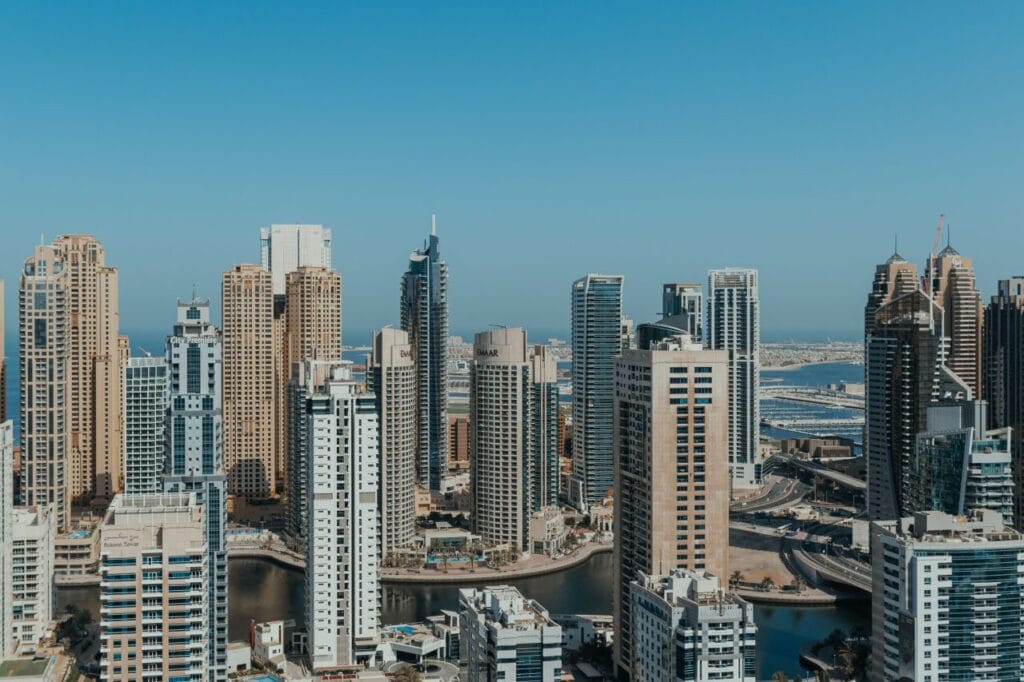
The most expensive mistake you can make in the UAE is paying for a prestige license when your business model only requires operational efficiency. It’s a common trap for entrepreneurs caught in the RAKEZ vs DMCC debate. You want the best for your startup, but you’re likely tired of opaque fee schedules and consultants who hide the true cost of visa logistics. We understand that fear of choosing a zone that limits your banking options or drains your capital before you even launch.
That’s why we’ve cross-referenced official fee schedules as of February 2026 to give you a clinical, apples-to-apples comparison. You’ll discover the precise data needed to decide if the DMCC’s commodity hub status justifies its premium or if RAKEZ’s industrial flexibility is your actual “Right Fit.” Here’s where it gets interesting: we’ve stripped away the promotional jargon to reveal the unflattering figures often left out of the brochures.
Our analysis provides a forensic breakdown of setup costs and visa processing timelines. You’ll get a clear view of the total investment required for both zones without the typical broker bias. Let’s dive into the data.
Key Takeaways
- Spot the difference between a base license quote and the actual total cost of ownership, including medical, insurance, and Emirates ID fees.
- Evaluate the global prestige of the Dubai Diamond Exchange against the industrial scalability of the Northern Emirates to find your operational home.
- Navigate the RAKEZ vs DMCC landscape with a clinical breakdown of visa processing logistics and banking compatibility verified for June 2026.
- Discover why tech startups and global trading houses often choose different jurisdictions based on long term scaling costs rather than just initial setup fees.
- Use our “Right Fit” framework to bypass marketing fluff and identify which zone aligns with your specific industry requirements and budget.
Understanding the Fundamental Landscape: RAKEZ vs DMCC in 2026
Choosing between two of the most prominent UAE free zones requires a look past the glossy brochures. By 2026, the distinction between RAKEZ vs DMCC has evolved from a simple matter of location to a complex choice of operational infrastructure. While DMCC sits in the urban heart of Jumeirah Lake Towers, RAKEZ offers a sprawling industrial footprint across Ras Al Khaimah. These aren’t just different cities; they represent different economic philosophies.
Historically, DMCC positioned itself as the global hub for hard commodities like gold, diamonds, and tea. RAKEZ, on the other hand, focused on being the backbone of the Northern Emirates’ manufacturing sector. Today, digital transformation has changed the game. You can now manage a RAKEZ company from a Dubai coffee shop just as easily as a DMCC entity. The physical gap has closed, but the jurisdictional DNA remains distinct. Which one aligns with your five year plan?
The Core Value Propositions
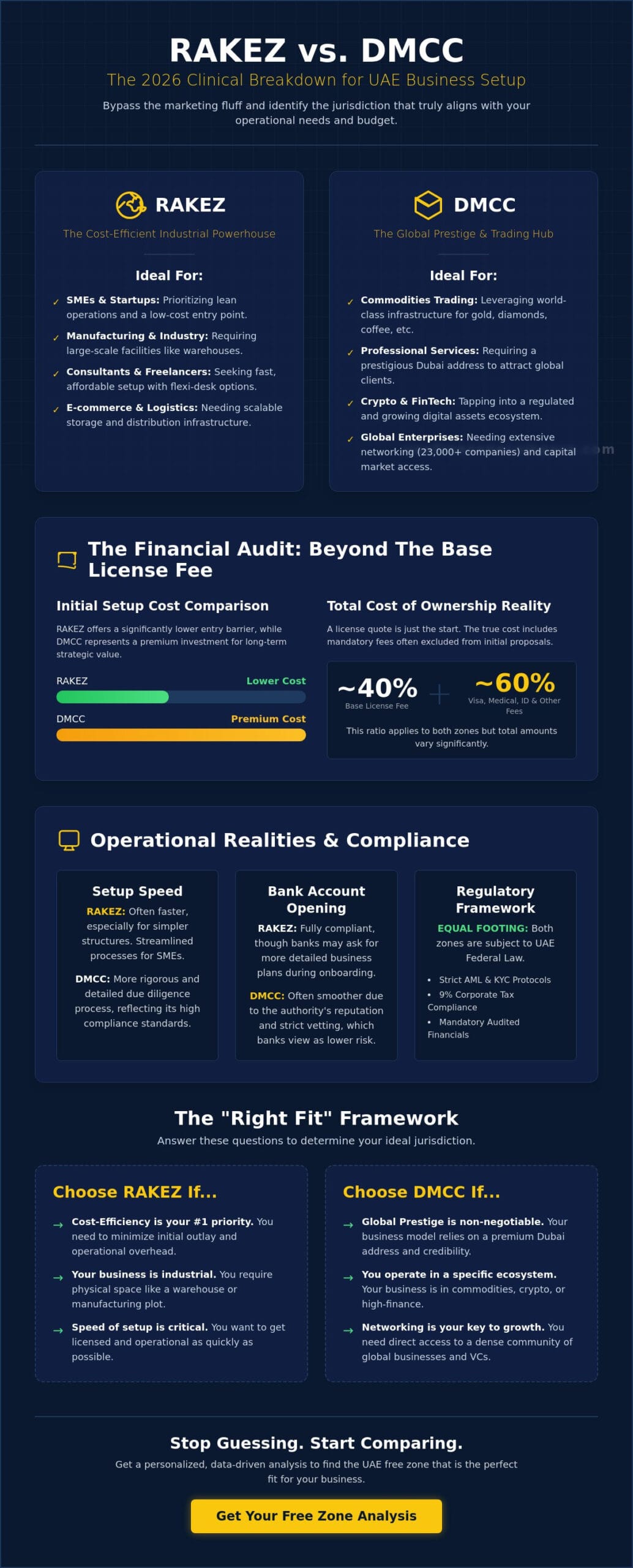
RAKEZ serves as a cost efficient powerhouse, specifically designed for SMEs and heavy industry. It provides a unique blend of flexi-desks for consultants and massive warehouses for manufacturers. On the flip side, DMCC is the undisputed champion of professional services and high value trading. It offers an address that carries significant weight with international banks and venture capitalists. You’re essentially choosing between the lean bottom line of the Northern Emirates and the high visibility prestige of Dubai.
Does your business need 500 square meters of storage or a boardroom overlooking the Marina? If you’re a freelancer, RAKEZ often wins on pure setup speed and lower entry costs. If you’re a commodities trader, the ecosystem at DMCC is unmatched. Both are valuable, but for entirely different reasons.
Regulatory Oversight and Compliance
The regulatory environment in 2026 is more unified than ever thanks to the UAE Corporate Tax framework. Both zones require strict adherence to Anti-Money Laundering (AML) and “Know Your Customer” (KYC) protocols. DMCC is regulated by its own authority, known for rigorous compliance standards that satisfy global auditors. RAKEZ follows a similarly robust path but often feels more accessible for smaller entities. Document attestation in RAK is generally faster, while Dubai’s processes are more integrated with international digital verification systems. To streamline these legal requirements, many businesses use Insta Notary Services to handle their official documentation correctly.
That said, both jurisdictions now require audited financial statements to maintain tax compliance under the 9% federal corporate tax rate. You won’t find a shortcut in either zone when it comes to federal law. Here’s where it gets interesting: the ease of opening a corporate bank account often hinges on which zone you choose. Banks frequently view DMCC entities as lower risk due to the authority’s strict vetting process. RAKEZ companies are equally legitimate, but you might face more granular questioning during the onboarding phase.
DMCC: The Infrastructure of a Global Commodities Hub
DMCC isn’t just a regulatory body; it’s a physical city within a city. Located in Jumeirah Lake Towers (JLT), this zone comprises over 80 towers clustered around three lakes. When considering RAKEZ vs DMCC, you must account for the reality of JLT’s urban density. High demand for office space here means that “flexi-desk” options are more restrictive compared to the Northern Emirates. If your business requires a physical presence to impress clients, the JLT skyline provides immediate credibility that’s hard to replicate elsewhere.
To navigate the competitive market for office and residential spaces in and around JLT, you can check out Chainex Real Estate for professional guidance.
The infrastructure is specifically engineered for high value trade. The Dubai Diamond Exchange and the DMCC Coffee Centre aren’t just marketing labels. They’re operational facilities that handle billions of dollars in physical assets annually. This specialized focus is why global trading houses choose this jurisdiction. They need more than just a license; they need a secure, world class supply chain ecosystem. Banks favor DMCC because of its rigorous KYC (Know Your Customer) standards, often leading to faster corporate account approvals compared to less regulated zones.
Networking and Ecosystem Benefits
With over 23,000 registered companies as of early 2026, the networking potential is staggering. You’ll find yourself surrounded by specific clusters in energy, financial services, and the growing crypto sector. Proximity to the Dubai International Financial Centre (DIFC) and Nasdaq Dubai provides a bridge to regional capital markets. If you’re looking to scale through venture capital or institutional investment, being in this hub simplifies the due diligence process for your partners. It’s often helpful to compare these ecosystem costs against your projected growth to see if the premium is justified.
DMCC Operational Logistics
The DMCC portal is a benchmark for digital government services in the UAE. Most processes, from license renewal to visa applications, are fully digitized and highly efficient. However, your team size is strictly dictated by your physical office footprint. The standard rule generally allocates one visa for every 9 square meters of office space. This means scaling your staff requires a proportional increase in your rent, a “hidden” cost that many consultants fail to highlight. Premium service tiers are available for those who need 24-hour document turnaround, but these come with a significant price tag for the speed.
RAKEZ: Versatility and Scalability for Modern Industry
While the DMCC skyline dominates the urban landscape, RAKEZ operates on a scale that is horizontal and industrial. It spans over 33 million square meters of specialized zones, making it a heavyweight for physical operations. In the RAKEZ vs DMCC comparison, the choice often comes down to the nature of your footprint. If you need a skyscraper, you go to Dubai; if you need an Al Ghail Industrial Park warehouse with direct access to Saqr Port, you head north to Ras Al Khaimah.
Connectivity is the silent driver here. Saqr Port is the largest bulk handling port in the Middle East, managing over 100 million tonnes of cargo annually. For logistics and manufacturing firms, this proximity isn’t just a convenience; it’s a structural advantage that slashes transport overheads. You aren’t just buying a license; you’re plugging into a supply chain that links the UAE to global markets without the traffic congestion of a major metropolitan hub.
SME and Freelancer Support
The “Startup” culture in RAKEZ thrives because the barriers to entry remain lower than in Dubai. Their Flexi-Desk model allows you to secure a legal address and residency without the immediate burden of a multi-year office lease. This flexibility is a cornerstone of their 2026 strategy. Here’s where it gets interesting: the 2026 “Dual License” option now allows free zone entities to trade in the UAE mainland via an agreement with the RAK Department of Economic Development. This removes the “either/or” dilemma that used to plague new entrepreneurs.
You can choose from highly customizable packages covering e-commerce, media, or general trading. These aren’t rigid templates. You can pivot your license type as your revenue grows. This adaptability makes it a natural home for consultants who want to keep their burn rate low while maintaining full access to the UAE market.
Industrial and Warehouse Capabilities
On the flip side, RAKEZ truly shines when it comes to heavy industry. They offer pre-built warehouses ranging from 150 to 500 square meters, equipped with high-capacity power supplies that manufacturing entities require. You don’t have to wait months for utility connections. Most plots come with “plug-and-play” infrastructure already verified for 2026 standards.
The logistics of human capital are also handled differently here. RAKEZ provides dedicated worker accommodation zones within the industrial parks. This significantly reduces the logistical “chaos” of transporting staff from remote residential areas. When you compare this to the high-cost residential environment surrounding JLT, the impact on your operational budget becomes clear. It’s a clinical choice: do you prioritize the prestige of a Dubai address or the logistical efficiency of an industrial powerhouse?
The Financial Audit: Analyzing License Fees and Freezone Visa Costs
The true cost of a business setup isn’t found on the first page of a brochure. It’s buried in the renewal fees and the logistical tail of residency visas. When we conduct a clinical RAKEZ vs DMCC audit, the primary differentiator is the “total cost of ownership” over a three year cycle. While initial setup fees might look competitive, the recurring expenses for physical office space and mandatory compliance vary significantly between the Northern Emirates and Dubai.
By February 2026, the gap between virtual and physical presence has widened. DMCC remains strict on physical office requirements to unlock higher visa options. RAKEZ continues to offer more flexibility with its Flexi-Desk model, which is ideal for lean startups. However, you must factor in the impact on your banking profile. Many Tier 1 UAE banks prioritize entities with physical premises in Dubai, meaning the “cheaper” setup might lead to higher costs in time and effort during the corporate account opening phase.
Forensic Visa Cost Breakdown
The “hidden” cost of a visa goes far beyond the government sticker price. You’re paying for the medical fit test, the Emirates ID (EID) registration, and the logistical movement of original documents. For those operating outside the free zone’s immediate vicinity, using Zajel courier services is a standard 2026 requirement for efficient document handling. Here’s what you need to account for:
- Investor vs. Employee: Investor visas typically have a longer validity but higher upfront deposits in certain jurisdictions.
- Mandatory Insurance: In DMCC, health insurance is a non-negotiable requirement for visa issuance. RAKEZ has historically been more flexible, though federal 2026 guidelines are pushing for more uniformity.
- Logistics: Factor in at least two courier trips for passport stamping and EID collection.
License and Renewal Transparency
Multi-year licenses are often pitched as a saving, but they require significant upfront capital. You should only commit to a three year license if your business model is verified and stable. On the flip side, adding shareholders or changing your license activities mid-year can incur administrative fees that vary by up to 40% between these two zones.
Compliance is the final financial hurdle. Under the 9% UAE Corporate Tax regime, your audit requirements have become a critical line item. DMCC has a list of approved auditors and strictly enforces annual filing. RAKEZ is equally compliant but often provides a broader range of approved firms, which can lower your annual professional fees. For a deeper look at these recurring costs, refer to our Auditor’s Guide. If you’re ready to see the raw numbers for your specific industry, you can compare real-time fee schedules now.
The Right Fit Framework: Aligning Business Goals with Jurisdiction
The “best” free zone is a myth often sold by consultants chasing commissions. In reality, the RAKEZ vs DMCC choice is about selecting the right financial tool for your specific operational scale. We’ve spent the previous sections dissecting the clinical data, from visa logistics to industrial infrastructure. Now, it’s time to apply a “knowledgeable friend” filter to these facts. How do these numbers translate into your daily business life in 2026?
While choosing the right jurisdiction is a vital first step, many entrepreneurs also look for deeper insights into their professional path; AstroWealth provides specialized reports designed to help you align your business journey with financial growth.
Success in the UAE depends on how well you align your jurisdiction with your client base. If you’re providing B2B professional services to multinational corporations, the JLT address carries a weight that justifies its higher price point. On the flip side, if you’re building a B2C e-commerce brand or a manufacturing firm, your customers care about your delivery speed and price, not your office view. Why pay for a Dubai premium when your value proposition is built on operational efficiency?
Scenario-Based Selection
Scenario A involves the Solo Consultant who wants a Dubai-centric lifestyle. You’ll likely spend your days meeting clients in Downtown or DIFC. While RAKEZ is more budget-friendly, the daily commute or the perceived distance might hinder your networking. DMCC places you in the heart of the action, making it the logical choice for those whose business is built on physical presence and high-frequency meetings.
Scenario B focuses on the International Trading firm moving bulk goods. Here’s where it gets interesting: the proximity to Saqr Port and the massive warehouse capabilities of RAKEZ offer a structural advantage that DMCC simply cannot match. You’re trading the prestige of JLT for the logistical power of Ras Al Khaimah. For a firm handling industrial raw materials or large-scale logistics, the RAKEZ bottom line is significantly more attractive.
Scenario C is for the Tech Startup prioritizing R&D. You need to keep your burn rate low while you iterate on your product. RAKEZ offers the most flexible entry point, allowing you to scale your visa options only when you’re ready to hire. That said, if you’re planning a Series A funding round in 2027, the banking credibility of a DMCC license might save you months of due diligence headaches with skeptical investors.
Final Checklist for 2026 Setup
Before you sign any contracts, perform this final clinical audit to ensure your choice is future-proofed for 2027 and beyond. Which zone allows you to expand into the mainland most easily? Does your chosen zone have a verified track record of handling the new 9% Corporate Tax filings without administrative chaos? Use this checklist to verify your “Right Fit” setup:
- Clinical Audit: Verify the June 2026 fee schedule for your specific activity.
- Visa Options: Cross-reference your 3-year hiring plan with the office square footage requirements we analyzed in Section 2.
- Banking Check: Confirm with your preferred bank if they have specific “onboarding appetites” for your chosen jurisdiction.
- Total Expenditure: Conduct an apples-to-apples comparison of total first-year costs, including those “hidden” courier and medical fees.
Choosing between RAKEZ vs DMCC isn’t a permanent verdict on your company’s worth. It’s a strategic decision based on today’s data and tomorrow’s goals. Are you ready to prioritize prestige or the bottom line?
Securing Your Verified 2026 Business Foundation
Deciding between RAKEZ vs DMCC isn’t just a choice of location; it’s a strategic commitment to a specific operational model. You’ve seen how DMCC’s commodity hub status and JLT visibility provide a bridge to global capital markets. On the flip side, RAKEZ offers an industrial scale and flexi-desk efficiency that’s unmatched for lean startups and manufacturers. Both jurisdictions are valuable, provided they align with your 3 year growth plan and banking requirements.
We’ve stripped away the marketing fluff to give you a forensic look at the numbers. Now, it’s time to apply this data to your specific business activity. You can compare 52 UAE Free Zones side-by-side with our independent cost calculator to see the precise breakdown for your industry. Our data is verified as of June 2026 and we never accept commission-based referrals. This independence ensures you get the truth about your setup costs, zero surprises included.
You’re now equipped to move past the chaos of traditional consultancy and make a decision based on clinical facts. Your business deserves a foundation built on transparency and objective data; to further refine your roadmap, you can visit Grad-Ex Consultancy to discover expert solutions for your GCC market expansion.
Once your business foundation is secure and you’ve navigated the complexities of UAE setup, consider rewarding your hard work with a trip to a premier destination like Cozumeldivehub, which offers world-class diving for those who appreciate precision and quality in every aspect of life.
Frequently Asked Questions
Is a RAKEZ visa valid for living in Dubai?
Yes, a residency visa issued by RAKEZ allows you to live anywhere in the UAE, including Dubai. Federal law permits residency in any of the seven emirates regardless of which free zone sponsors your visa. This remains a standard regulation verified for 2026, offering you the flexibility to maintain a business in Ras Al Khaimah while residing in the heart of Dubai.
What is the average freezone visa cost for an investor in 2026?
The total expenditure for an investor visa includes the entry permit, status adjustment, medical fitness test, and Emirates ID fees. You must also factor in the mandatory health insurance premiums, which vary based on your age and coverage level. These costs are subject to federal updates from the ICP, so we recommend checking the latest official fee schedules for a precise breakdown.
Does DMCC require a minimum share capital for all business activities?
Yes, DMCC generally requires a minimum share capital of AED 50,000 for most standard license types. Certain specialized activities, such as commodity trading or financial services, often demand higher capital requirements. You’ll need to deposit this amount into a UAE bank account within a specific timeframe after your company is incorporated to remain compliant with the authority’s regulations.
Can I open a corporate bank account with a RAKEZ license?
You can certainly open a corporate bank account with a RAKEZ license at both local and international banks in the UAE. That said, banks often apply more rigorous due diligence if you’re using a flexi-desk rather than a physical office. The RAKEZ vs DMCC choice can influence your banking journey, as some institutions perceive Dubai-based zones as lower risk during the initial KYC phase.
How long does the visa processing take in DMCC compared to RAKEZ?
Visa processing in DMCC typically takes 10 to 15 working days once the entry permit is issued. RAKEZ follows a similar timeline, though its centralized processing in Ras Al Khaimah can sometimes result in faster medical and Emirates ID appointments. Both zones offer expedited “VIP” services if you need to bypass the standard queue for a faster turnaround.
Are there hidden fees in the RAKEZ “cheapest” license packages?
The entry-level prices often exclude mandatory line items like E-channel registration, establishment card fees, and the 5% VAT. You should also check if the package includes the annual audit requirement or if that’s an additional cost. We always suggest a clinical review of the full fee schedule to avoid surprises during your first renewal cycle.
Do I need to visit the UAE to complete my DMCC setup?
You can start the license application remotely through the DMCC digital portal, but you must be physically present for the residency visa stage. The medical fitness test and Emirates ID biometrics require your physical presence in the UAE. While some consultants offer power of attorney services for document signing, the mandatory health checks cannot be completed from abroad.
Can I switch my license from RAKEZ to DMCC later?
You cannot directly transfer a license between these two independent authorities. Switching requires you to liquidate your existing RAKEZ entity and begin a completely new incorporation process with DMCC. This means paying full setup fees again and canceling your current visas, which is why we emphasize picking your “Right Fit” jurisdiction from day one.
Written by: UAE Freezone Compare Editorial Team
Reviewed by: UAE Business Setup Research Team
Last reviewed: June 2026
Our guides are reviewed using public authority information, official package pages, available fee schedules, partner quotations and manual research. Prices and requirements can change depending on activity, visa count, office requirement, shareholder structure and authority approval.
Calculate My Free Zone Cost Compare free zones Browse activities Bank account guide
FAQs
| Are prices final? | No. Request the current verified quote before committing. |
|---|---|
| Can requirements change? | Yes. Free zone and bank requirements can change by activity, visas, office and shareholder profile. |