
What Does It Cost to Form a Company in Ajman Free Zone in 2026?
Ajman Free Zone company formation costs in 2026 start from AED 6,500–12,000 for a basic licence, plus mandatory extras — E-channel registration, establishment card, visa packages, and workspace fees — that typically add AED 4,000–8,000. Total first-year investment for a one-visa setup ranges from AED 12,000–22,000 depending on activity and package.
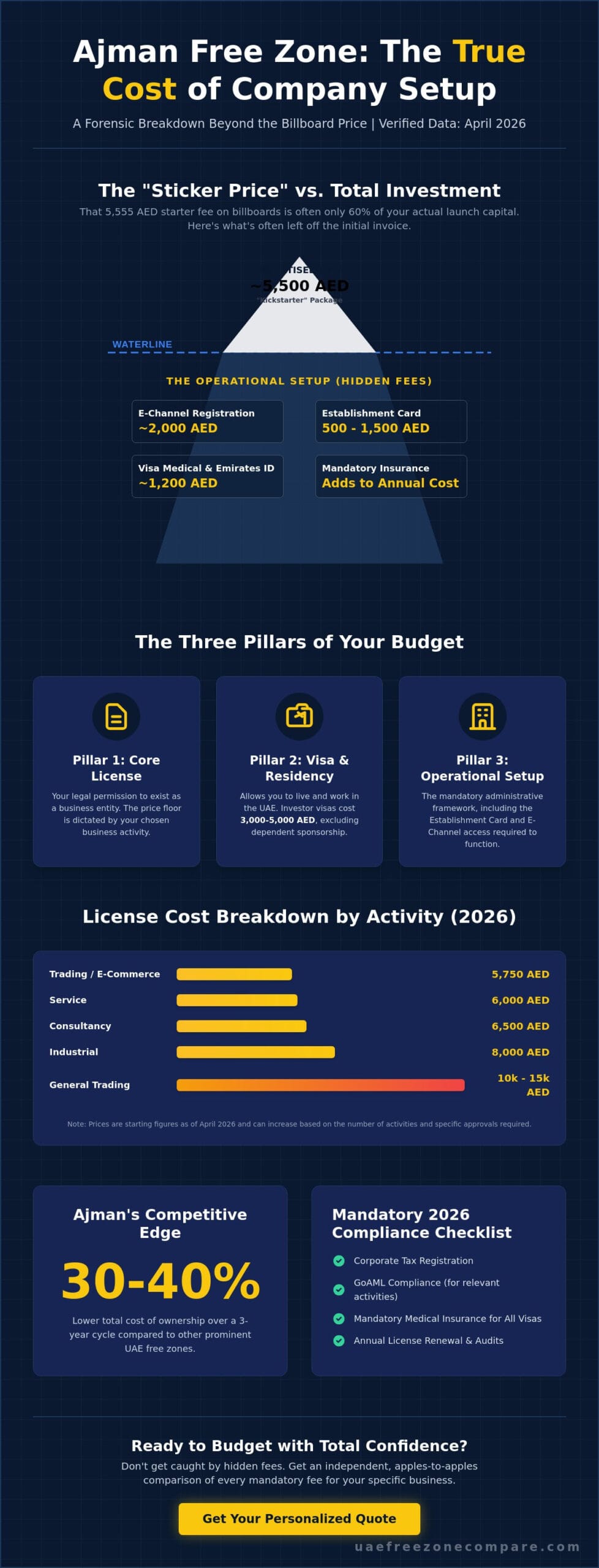
What if the 5,555 AED starter fee you see on billboards is only 60% of the capital you actually need to launch? It’s a common frustration for entrepreneurs who find that the initial AJMAN Free Zone company formation cost quickly balloons once medical checks, E-channel registrations, and mandatory establishment cards are added to the invoice. We understand how exhausting it is to hunt for a straight answer when every “all-inclusive” package seems to have a hidden footnote.
We believe you deserve a forensic look at the numbers, free from the marketing fluff of traditional consultancies. In this 2026 breakdown, we’ll peel back the layers on everything from the 5,499 AED Kickstarter package to the complex 12,999 AED visa structures. You’ll get an independent, apples-to-apples comparison of every mandatory fee, a checklist of compliance costs for this year, and the data you need to open a corporate bank account without the usual headaches. Let’s look at the verified April 2026 figures so you can budget with total confidence.
Key Takeaways
- Learn to separate the “sticker price” of a base license from the total operational capital required to actually start trading legally.
- We break down the true ajman free zone company formation cost by factoring in frequently overlooked line items like the 2,000+ AED E-Channel registration fee.
- Discover how to optimize your visa options by matching your specific business activity to the most cost-effective workspace solution available in 2026.
- Identify the latest regulatory requirements, including mandatory Corporate Tax registration and GoAML compliance, to ensure your budget accounts for all 2026 overheads.
- Use our “Right Fit” framework to determine whether a lean freelancer package or a scalable trading setup aligns best with your growth strategy.
Decoding the Ajman Free Zone (AFZ) Cost Structure in 2026
Updated June 2026 data shows a pivot in how the Ajman Free Zone (AFZ) structures its entry-level fees. While many jurisdictions are raising baseline prices to match inflation, Ajman has unbundled several services to provide more granular control for investors. This means the initial ajman free zone company formation cost looks lower on paper, but you’re now responsible for individual regulatory registrations that were previously bundled. It’s a move toward transparency, but it requires a sharper eye on the final invoice to avoid mid-process surprises.
We need to distinguish between the Core License and the Operational Setup. A Core License is simply your legal permission to exist as a business entity. The Operational Setup includes the mandatory establishment card, E-channel access, and visa options that actually allow you to work and live in the UAE. If you only budget for the license, you’ll be grounded before you even start. It’s the clinical reality of the 2026 market; license-only quotes are often used as bait to get investors through the door.
Why choose Ajman? For budget-conscious startups, it remains a powerhouse. License fees here are frequently 30% to 40% lower than comparable options in other prominent free zones. That said, the location isn’t just geographical; it’s a trade-off between the perceived prestige of certain business hubs and the raw utility of a lower overhead. For more than 9,000 businesses already operating here, the math simply works better.
The “Apples-to-Apples” Comparison Framework
When UAE Freezone Compare evaluates neighboring business hubs, we ignore the “Year 1” promotional discounts. These are often marketing traps that double in price upon renewal. We focus on the Total Cost of Ownership (TCO). Total Cost of Ownership is the cumulative sum of license fees, mandatory government portal access, and residency costs over a three-year cycle. This is the only way to see if Ajman is truly the “Right Fit” for your long-term goals.
Understanding License Categories and Their Price Impact
Your industry dictates your price floor. As of April 2026, a standard Service License starts around 6,000 AED, while Industrial Licenses jump to 8,000 AED due to additional environmental and safety inspections. Here’s where it gets interesting: the number of activities you choose matters. Most starter packages include up to five activities, but adding a sixth can trigger a price hike. If you’re eyeing a General Trading license, prepare for a premium. These licenses often carry higher registration fees, typically between 10,000 and 15,000 AED, because they allow for the widest range of imports and exports.
The Three Pillars of Setup: License, Visa, and Workspace Fees
To build a realistic budget, you need to look at three non-negotiable pillars: your license, your visa options, and your workspace. For 2026, the Ajman Free Zone has adjusted the mandatory Establishment Card fees, which now range between 500 and 1,500 AED for the initial registration. While the license gives you the legal right to operate, these administrative pillars dictate your actual ability to hire staff or reside in the country. Understanding how these costs interact is the only way to arrive at a precise ajman free zone company formation cost. For comprehensive guidance and tailored comparisons, platforms like UAE Freezone Compare can be invaluable.
License Cost Breakdown by Activity
As of April 2026, a consultancy license starts at 6,500 AED, while service-based activities begin at 6,000 AED. Trading licenses are slightly more competitive at 5,750 AED. Here’s where it gets interesting: your inventory type matters. If you’re trading specialized goods, you might trigger additional regulatory approvals that carry their own administrative fees. Digital entrepreneurs should budget 5,750 AED for an e-commerce license, but keep in mind that mandatory portal registrations are now a standard part of the 2026 setup process.
Visa and Residency Expenditure
Visa costs are where many founders lose track of their budget. An investor visa typically ranges between 3,000 and 5,000 AED, a figure that includes your medical fitness test and Emirates ID. On the flip side, don’t overlook the “Dependent Visa” trap. Sponsoring family members requires separate deposits and file opening fees that can easily double your initial residency outlay. Since early 2026, medical insurance has become a strictly non-negotiable part of the visa stamping process. Basic plans add a predictable but necessary layer to your annual overhead. You can use UAE Freezone Compare to compare these visa bundles against other emirates to see which offers the best long-term value for your family.
Workspace Solutions: Flexi-Desk vs. Physical Office
The Flexi-Desk remains the entry point for most, costing between 4,000 and 12,000 AED per year. It’s an ideal route for digital nomads who don’t need a permanent physical footprint. That said, some licenses require a dedicated office or warehouse lease to satisfy regulatory requirements. These physical spaces start around 15,000 AED and can reach 30,000 AED annually. Be sure to check for hidden utility and maintenance fees in AFZ business centres. These minor charges for high-speed internet or cooling can quietly erode your margins if they aren’t accounted for in your initial forecast.
Beyond the Invoice: Identifying Hidden Fees and Mandatory Overheads
Have you ever noticed how the most attractive “all-in” packages seem to omit the paperwork that actually makes your business legal? While we’ve already discussed licenses and desks, the true ajman free zone company formation cost includes several administrative layers that consultants often bury in the fine print. These aren’t optional upgrades; they’re the regulatory gears that keep your company moving. If you’re building a three-year financial forecast, these are the line items that will determine your actual burn rate.
The Immigration and E-Channel Layer
The most significant surprise for many is the E-Channel registration, which typically carries a one-time entry fee of 2,000 AED or more. This digital portal is essential for managing your company’s visa applications and residency status. The E-Channel system is a unified digital platform that streamlines visa processing and immigration services for businesses operating within the UAE free zones. On top of this, you’ll need an Establishment Card. This card is the first document issued after your license, acting as your company’s ID with the immigration department. For 2026, keep an eye on renewal costs, as the latest fee schedules show a modest price hike for annual establishment card maintenance.
External Approvals and Regulatory Sign-offs
Depending on your specific activity, your license might stay “pending” without external approvals. If you’re in healthcare, education, or heavy industry, you may need sign-offs from the Ministry of Health (MoH), the Ministry of Education (MoE), or Civil Defence. These approvals aren’t just administrative hurdles; they often come with their own inspection fees and document processing costs. Identifying these requirements early prevents a bottleneck three weeks into your application. On the flip side, most standard consultancy or trading activities in Ajman bypass these extra steps, keeping your initial timeline lean.
Banking and Financial Setup Costs
Opening a corporate bank account is the final, and often most difficult, hurdle for international investors. While many banks advertised “Zero Balance” accounts in previous years, the reality in 2026 is much more clinical. Most Tier 1 banks now require a minimum average balance or charge a monthly fee if your liquidity drops below a specific threshold. You might also consider professional assistance to navigate the compliance-heavy KYC (Know Your Customer) process. While fees for this support vary, budgeting at least 5,000 AED for miscellaneous financial setup and accounting costs is a prudent move. For a deeper dive into these secondary expenses, read The Auditor’s Guide to UAE Free Zone Company Setup Costs (2026) to ensure your financial forecast is bulletproof.
Right-Sizing Your Setup: Which Package Fits Your Business Model?
Choosing the right setup isn’t about finding the cheapest sticker price; it’s about aligning your overhead with your actual operational needs. The ajman free zone company formation cost varies significantly between a digital nomad who requires zero visas and a trading firm that needs a physical warehouse. We use a “Right Fit” framework to help you identify which path makes sense for your specific business stage. This ensures you don’t overpay for a visa options you’ll never use or a workspace that doesn’t serve your daily workflow.
Scenario A: The Solo Consultant (0 to 1 Visas)
If you’re a service provider or a freelancer, the Kickstarter package is often the most logical entry point. For a license fee of approximately 5,499 AED, you get a business license and access to a co-working space. That said, your total Year 1 outlay will be higher once you factor in the mandatory E-channel and establishment card fees we discussed earlier. You should budget roughly 9,000 to 10,000 AED to get fully operational without a residency visa. On the flip side, if you need a visa, the Freelancer package at 11,999 AED covers your residency, medical, and Emirates ID costs in a single bundle.
Scenario B: The SME Importer (2 to 5 Visas + Warehouse)
Moving from a virtual desk to a physical footprint represents the biggest leap in your initial capital outlay. A trading license starts at 5,750 AED, but adding a dedicated warehouse can cost between 15,000 and 30,000 AED annually. Here’s where it gets interesting: physical space usually unlocks a higher visa options, allowing you to hire a small team immediately. You also need to account for VAT registration if your taxable turnover exceeds 375,000 AED. At this scale, professional accounting support becomes a mandatory operational cost rather than a luxury. You can compare these warehouse costs to ensure optimal value and the most square footage for your budget.
That said, Ajman might not be the right choice for every business model. If your clients require a high-prestige address in Dubai’s financial district for perception reasons, the savings here might be offset by a loss in brand authority. Similarly, if your logistics are heavily tied to Jebel Ali Port, the transport costs from Ajman could erode the benefits of a cheaper license. It’s about clinical math; if the logistical or brand trade-offs cost more than the 30% you save on fees, it’s worth exploring solutions that better align with your strategic priorities. We focus on these unflattering truths so you can make a decision based on data rather than marketing brochures.
Long-Term Viability: Compliance Costs and Your Next Steps
Launching your business is a significant milestone, but maintaining its legal standing is where the real work begins. In 2026, the regulatory landscape in the UAE has shifted toward higher transparency and stricter reporting. This means the true ajman free zone company formation cost includes a secondary layer of “silent” compliance fees that aren’t always visible on a standard invoice. If you don’t budget for these from day one, you might find your Year 2 renewal costs higher than anticipated. We believe in looking at the clinical reality of these overheads before you commit your capital.
Mandatory Compliance in 2026
Corporate Tax registration is now the headline act for every new entity in the Ajman Free Zone. Even if your business qualifies for the 0% rate on qualifying income, you’re legally required to register with the Federal Tax Authority (FTA). Failing to meet registration deadlines can result in administrative penalties that quickly erode your startup savings. On the flip side, you also need to navigate Economic Substance Regulations (ESR). If your activity involves “Relevant Activities” like shipping, banking, or distribution, you must file annual notifications to prove your business actually operates within the UAE.
Anti-Money Laundering (AML) and GoAML registration fees are another critical consideration for 2026. These registrations are mandatory for “Designated Non-Financial Businesses and Professions,” which includes many trading and consultancy setups. While the registration itself might be low-cost, the administrative time required to maintain these records is a factor. Additionally, don’t overlook Ultimate Beneficial Owner (UBO) filing. It’s a small but vital compliance step that requires you to declare who actually controls the company. Most trading licenses in Ajman are also bound by annual audit requirements, meaning you’ll need to factor in the cost of a UAE-approved auditor to sign off on your financial statements.
Final Checklist for Your Ajman Setup
Before you transition from research to execution, you need to verify your numbers one last time. Most entrepreneurs overpay because they rely on “brokers” who add substantial margins to standard government fees. We recommend a “Zero Hidden Cost” verification process where you cross-reference every quote against official fee schedules. Start with your base license, add the 2,000+ AED E-channel fee, and include your specific visa and medical insurance costs. This forensic approach ensures you aren’t surprised by an “add-on” fee in the middle of your application.
Ready to see how these figures stack up against other jurisdictions? You can Compare Ajman Free Zone costs with 40+ other UAE zones here to find the setup that aligns with your specific budget and growth goals. It’s the most efficient way to move forward with better cost visibility, ensuring you don’t spend a dirham more than necessary. By using independent data rather than sales brochures, you position your business for long-term viability in the competitive UAE market.
Securing Your Business Future in Ajman
You’ve seen the data and decoded the layers of the ajman free zone company formation cost for the current fiscal year. By distinguishing between the core license and the total operational setup, you’re already ahead of most entrepreneurs entering the UAE market. Remember that 2026 brings new compliance mandates like Corporate Tax and AML registrations that must be factored into your long-term burn rate. This forensic approach protects your capital and ensures your startup remains viable beyond the first twelve months.
We believe that radical independence is the only way to navigate the “chaos” of traditional setup procedures. Our platform offers an independent comparison of 51 UAE Free Zones to help you find your “Right Fit” without the pressure of a sales pitch. Ready to finalize your budget with clinical precision?
Get a Precise 2026 Cost Estimate for Ajman Free Zone
Your path to a successful launch is now clear. We’re excited to see your business thrive with the confidence that only verified data can provide.
Frequently Asked Questions
Is Ajman Free Zone the cheapest in the UAE for 2026?
Ajman remains one of the most cost-effective jurisdictions, with license fees typically 30% to 40% lower than comparable hubs in Dubai. That said, the “cheapest” option depends entirely on your specific visa requirements and business activity. While it’s a high-value entry point for startups, you should always compare the total cost of ownership against Sharjah or Ras Al Khaimah to ensure it’s the right fit for your budget.
What is the minimum cost for a business license in Ajman?
The baseline entry point for 2026 is the Kickstarter package, which starts at 5,499 AED for a zero-visa setup. This package is designed for lean operations and allows for up to five business activities and five shareholders. If you require a residency visa, the price floor shifts to 11,999 AED for a Freelancer package, which bundles your license with medical and Emirates ID fees.
Are there any hidden fees when setting up in Ajman Free Zone?
The most frequent “hidden” ajman free zone company formation cost is the E-Channel registration, which adds roughly 2,000 AED to your initial bill. You must also account for the Establishment Card, which carries a registration fee between 500 and 1,500 AED. These are mandatory regulatory overheads that consultants often exclude from their initial “all-inclusive” quotes to make the base license appear more attractive.
How much does an investor visa cost in Ajman for 2026?
You should budget between 3,000 and 5,000 AED for an investor visa in 2026. This verified range includes the mandatory medical fitness test, Emirates ID application, and the visa stamping process itself. On the flip side, don’t forget that health insurance is now a non-negotiable requirement for visa approval, which adds a predictable but necessary layer to your annual residency expenditure.
Do I need a physical office to get a license in Ajman?
No, a physical office is not mandatory for most service and trading licenses in the Ajman Free Zone. Most entrepreneurs opt for a Flexi-desk solution, which starts at approximately 4,000 AED per year and satisfies the legal requirement for a registered business address. Physical leases are generally only required if your license has a high visa options or involves industrial activities like manufacturing or large-scale warehousing.
What are the annual renewal costs for an Ajman Free Zone company?
Your annual renewal cost is typically composed of your base license fee, the workspace lease, and the Establishment Card renewal. While the license fee stays relatively stable, remember that workspace costs can fluctuate based on market demand. It’s also important to account for any recurring compliance fees, such as those for Economic Substance Regulations (ESR) filings if your business activity falls within the mandatory reporting scope.
Can I open a bank account with an Ajman Free Zone license?
Yes, you can open a corporate bank account, but the process is more clinical than it was in previous years. Banks in 2026 require thorough Know Your Customer (KYC) documentation and often mandate a minimum average balance. While the ajman free zone company formation cost doesn’t include banking fees, you should budget at least 5,000 AED for professional assistance if you want to navigate the compliance-heavy application process smoothly.
Is Corporate Tax registration mandatory for new Ajman companies?
Yes, every new entity in Ajman must register for Corporate Tax with the Federal Tax Authority (FTA) regardless of its income level. While qualifying free zone companies can still benefit from a 0% tax rate on qualifying income, the registration process itself is a legal requirement. Failure to register within the government’s specified deadlines can lead to administrative penalties, making this a critical step in your 2026 compliance checklist.
Written by: UAE Freezone Compare Editorial Team
Reviewed by: UAE Business Setup Research Team
Last reviewed: June 2026
Our guides are reviewed using public authority information, official package pages, available fee schedules, partner quotations and manual research. Prices and requirements can change depending on activity, visa count, office requirement, shareholder structure and authority approval.
Calculate My Free Zone Cost Compare free zones Browse activities Bank account guide
FAQs
| Are prices final? | No. Request the current verified quote before committing. |
|---|---|
| Can requirements change? | Yes. Free zone and bank requirements can change by activity, visas, office and shareholder profile. |